A product is mentioned during a major live event. Its description is read 24,000 times per second. Most requests hit a shared cache. At 12:00:00 the cached value expires, and database CPU rises sharply even though only one key is missing.
Interview question. Explain the thundering herd and design a safe refill path across 40 application instances. Decide what callers see while the first fetch runs, what happens if that fetch fails, and whether the cache can deliberately serve an older result. The product description can be a few seconds stale, but inventory availability cannot.
This question is about controlling how much work one cache miss launches across the application fleet. There is no requirement to split the underlying storage key.
Think first
A product description at 24,000 reads/sec expires and 40 application instances all miss. Explain a worst-case initial 200 ms burst, design per-process and fleet-wide coalescing, and choose how to behave if the refresh fails.
Take a few minutes to form an approach, then compare it with the worked explanation.
Reveal the worked explanation
A miss can multiply one query into thousands
At a steady 24,000 incoming requests per second, about 24,000 × 0.200 = 4,800 requests arrive during an initial 200-millisecond miss window. If the key remains missing throughout that window and each arrival immediately starts one database read, that means roughly 4,800 queries started—not 24,000 queries and not necessarily 4,800 queries executing simultaneously. Earlier refill, admission limits, queueing or coalescing can reduce the number actually started. Measure incoming requests, origin queries started and active query concurrency separately.
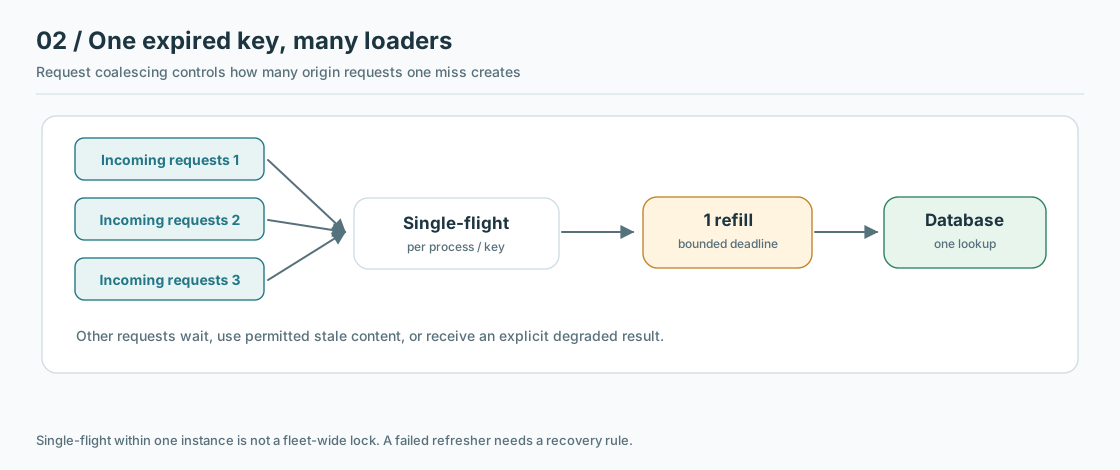
Twenty four thousand requests per second converge onto a single expired key and a bounded refill path
A naive retry makes matters worse. A database saturated by a flood of reads slows each miss. Slower responses leave more requests waiting, which can cause clients and gateways to time out and retry. The cache may appear healthy while the origin collapses.
In one process, I would use a per-key in-flight operation. The first caller starts the load. Concurrent callers for the same key await its result instead of executing identical queries. Go's singleflight implements that general idea, but it shares overlapping calls rather than permanently storing the result. We still need an actual cache and an expiry rule.
With 40 application instances, process-local coalescing permits approximately one origin fetch per active instance for this key, assuming overlapping requests and correct implementations. That is much better than thousands, but not necessarily one across the fleet. A shared cache with coordinated refresh, a bounded distributed claim, or a designated refresh owner can reduce duplicate work further.
Who should wait, and for how long?
The first caller should not hold everyone hostage indefinitely. Give the origin fetch a deadline. Other requests wait only inside their own budgets. If a waiter cancels, that does not automatically mean the shared origin fetch should be canceled for all remaining callers.
If the refresh fails, choose one explicit response strategy. For product description, a recent expired value may be useful. Keep a separately bounded stale representation, serve it while one refresher works, and stop serving it after the allowed stale window. HTTP's stale-while-revalidate and stale-if-error express related policies for compliant HTTP caches. They are not a blanket instruction to reuse arbitrary old application data.
For a price display or inventory decrement, serving stale may violate the user-facing contract. Under those requirements, waiting briefly, returning a degraded response, or rejecting admission is better than inventing availability. A database query for inventory authority cannot be replaced by copying yesterday's stock count into more caches.
An important edge case is the elected refresher crashing. A distributed claim must expire or be recoverable, or the key could remain frozen forever. But an expired claim does not cancel a query already in flight. A replacement refresh can race with the earlier one. Protect publication with a generation or conditional rule if data freshness requires it, rather than treating a lease as proof that all older work vanished.
Expiry is a load-shaping decision
A thousand keys expiring at one exact deployment timestamp can create a fleet-wide herd, even if no individual key is exceptional. I would spread expiry times with jitter where the business semantics allow it. For frequently used keys, probabilistic early refresh or background revalidation can smooth requests before the deadline.
Neither approach removes the need for origin admission control. If every cache disappears during a restart, nearly every key can miss at once. A system designed only to coalesce one hot key is not necessarily able to rebuild its entire working set. We will treat that separately in the final episode.
Metrics should distinguish the number of user misses from the number of actual origin fetches. A cache miss counter might show 24,000 per second while process-local coalescing permits roughly one overlapping origin fetch per participating instance. Compare misses and actual query starts over the same measurement window rather than equating request rate with a query count. Without both signals, on-call engineers may incorrectly conclude the database is overloaded or that the improvement did nothing.
I would instrument active refreshes per key, waiters per refresh, successful and failed origin fetches, stale responses by age, deadline rejections, and the fraction of requests served by a coalesced result. A single shared error can fan out to many users even while origin query counts look small, so successful user outcomes also matter.
Try this in an interview: The first fix is not “more Redis nodes.” It is to decide how concurrent misses share work and what callers do when the shared work cannot finish. For a bounded-stale description, one controlled refresh plus short-lived stale responses may work. For an authoritative operation, stale reuse is not an acceptable shortcut.
At the next deployment, the cache does not lose one key. The overall hit rate drops while request volume stays constant. We need to understand how much traffic that seemingly small percentage change sends to storage.
Go deeper
Distributed refresh locks can lower duplicate work but add their own coordinator availability assumptions. A lock alone is not sufficient for strong ordering of returned versions. Use a safe write-back rule, and decide whether coalesced callers share errors, receive a stale result, or retry later with jitter.
An early-refresh probability should depend on remaining TTL, expected refill cost, and measured request frequency. It should not refresh low-value keys so aggressively that background work overwhelms the backend. A fallible refresh must respect deadline budgets, not pile up an unbounded waiting queue.
The browser cache, CDN cache, gateway cache, and application cache may each have separate expiration policies. Coalescing at one layer does not automatically eliminate duplicate origin work from every layer.
Check your reasoning
Compute that roughly 4,800 requests may arrive during a 200 ms miss window at this rate.
Distinguish one in-flight operation per instance from a fleet-wide single refresh.
Bound wait and origin work, handling cancellation and refresher failure.
Use stale-while-revalidate only under an explicit freshness contract.
Handle expired claims and avoid assuming an old in-flight worker was physically canceled.
Common mistake: Saying singleflight is a distributed cache or that an expired lock guarantees older loaders stop working.
Read the answer explanation
As many as one per participating instance, absent shared coordination. — Local coalescing deduplicates only calls sharing that process or coordination namespace.
Apply it elsewhere
A token-price lookup expires during a burst. Is serving a stale price acceptable if trading decisions depend on it?
Compare your approach
Decide on the freshness and correctness contract first. Coalescing is still useful, but stale results may need rejection.
One more constraint
How does your design bound work if every instance restarts and the shared cache is cold?
Quick revision
When one hot key expires, concurrent misses can generate thousands of identical origin reads. Collapse in-flight work per key and bound origin requests and waiter deadlines. Process-local singleflight can still issue roughly one origin call from each participating instance. Fleet-wide coordination needs an additional shared mechanism and recovery from stale claims. Serve stale content only under an explicitly permitted freshness window. Record user misses separately from real database fetches, and do not confuse one hot-key herd with full-cache cold-start recovery.