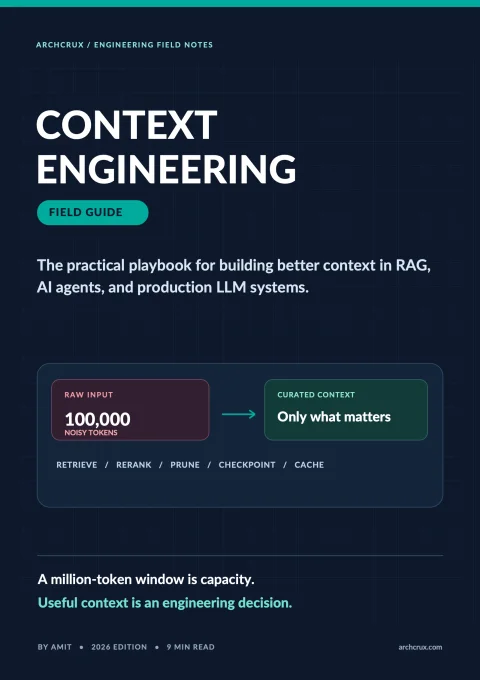
Field Guide 01 · Free PDF
Context Engineering
What should your AI actually see?
More context isn't always better. Learn how to select, structure, and evaluate the information your LLMs and agents receive.
No account required. No email required.
By Amit Kumar10-page PDF201 KB2026 edition
Inside the guide
What you will work through
A compact field guide to building the context your RAG systems and AI agents receive at every model call: what to retrieve, what to prune, what to carry forward as structured state, and how to prove a smaller context is still sufficient.
- Format
- PDF, 10 pages, 201 KB
- Access
- Free. No account or email.
- For
- Engineers building RAG systems, AI agents and production LLM applications.
- Updated
- 01p. 2
Long-context limits and Lost in the Middle
Why a context window measures capacity, not usefulness. Separates capacity, relevance and sufficiency, and treats the U-shaped position effect as a research observation rather than a universal curve.
- 02pp. 3–4
Context selection and prioritization
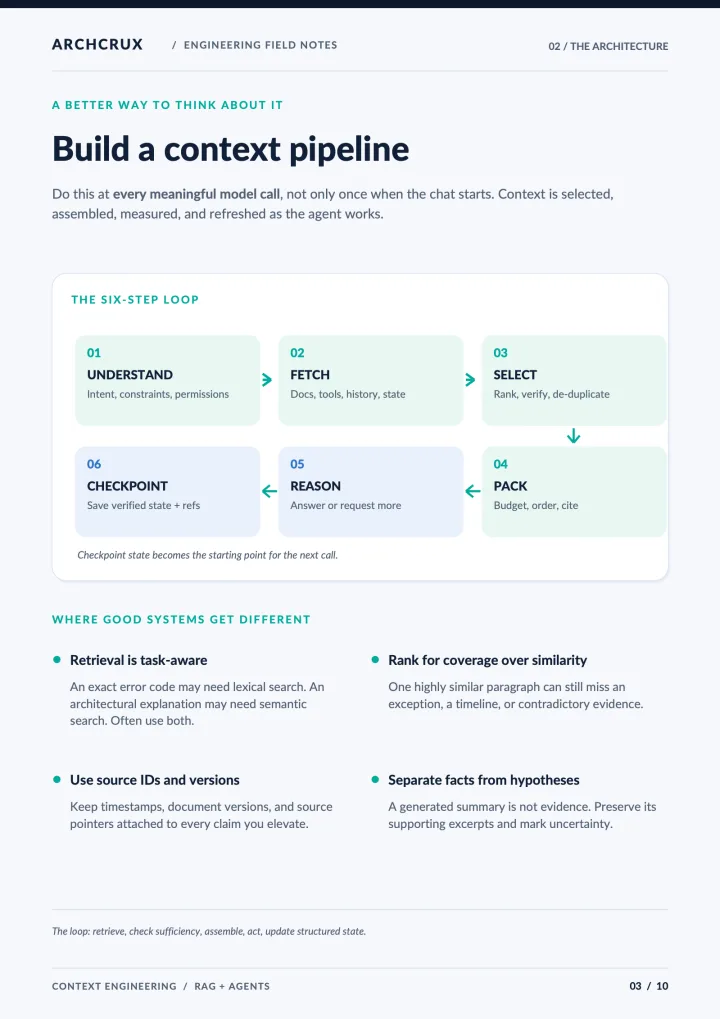
A six-step pipeline run at every meaningful call: understand, fetch, select, pack, reason, checkpoint. Covers hybrid lexical and dense retrieval, and reranking for coverage over similarity.
- 03pp. 4–5
Dynamic pruning and compression
Remove duplicate logs, superseded tool output and stale turns while preserving negative evidence and constraints. Compaction that pins critical qualifiers instead of silently erasing them.
- 04pp. 5, 7
Structured agent state
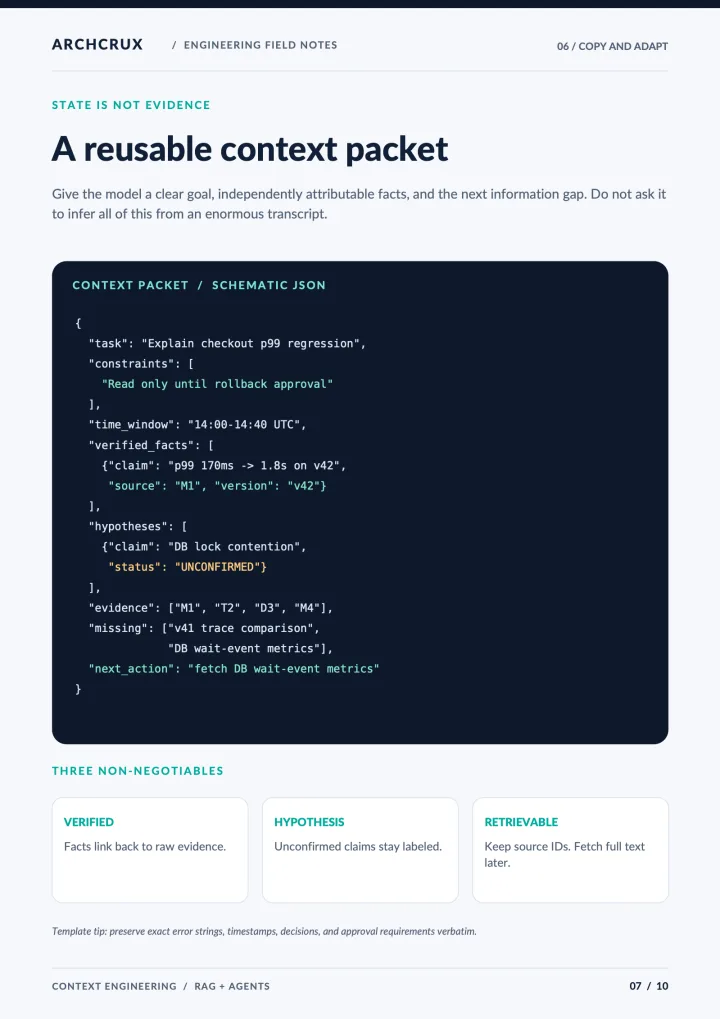
Progressive disclosure through pointers, and a reusable context packet that keeps verified facts, labeled hypotheses and missing evidence apart.
- 05pp. 5, 8
Context budgets and caching
An explicit token budget for the next call, a cost model that includes cached reads and writes, and why prefix caching speeds computation without making weak evidence reliable.
- 06pp. 6, 9–10
Worked example and production checklist
An illustrative incident-investigation agent reduced from 100,000 raw tokens to an 11,800-token packet, a three-way evaluation ablation, and a one-page implementation checklist with sources.
Preview
Two pages from the guide
Context Engineering Field Guide
10-page PDF · 201 KB · Free. No account or email required.
Continue learning
Go deeper on ArchCrux
Essay
Designing the Context Layer for Production AI Agents
Production AI agents need a context layer that assembles evidence, preserves authority and freshness, and separates model reasoning from durable workflow state.
Guide
Agent Memory vs Execution State
Separate reusable information from the durable state that records progress, tool effects, retries and ownership in an AI agent run.
Guide
AI Agent Architecture
A production AI agent architecture separates model decisions from context, tools, durable execution, permissions, evaluation and observability.
Essay
RAG in Production Is Mostly Not About Retrieval
Most RAG discussions obsess over retrieval. In production, the harder problems are ingestion, data lifecycle, generation control and evaluation.
Essay
How Coding Agents Actually Work: Inside the Agent Harness
A technical look inside coding agent harnesses, covering context management, repository search, tools, sandboxes, subagents, durable sessions, recovery, concurrency, completion and evaluation.
Reading paths:Production AI agents →RAG in production →