Agent Architecture · Principal
An agent changes an API used by twelve repositories. In what order can it ship?
The question
Interview question
A coding agent changes `CreateReservation` so callers must pass `travelerCountry`. It opens patches in twelve repositories and reports that all their tests pass. Four services are deployed independently, three clients run on customer infrastructure, and the rest are batch jobs that may wake up next month. The API owner wants one coordinated release tomorrow. Design the release. The field is needed for a new compliance decision, so silently inventing a country is unsafe.
Take a few minutes to form your approach. Then open a worked answer and compare the decisions.
Reveal a worked answer
First ask what the current contract actually promises. Is this an HTTP request, an event, or a generated client call? Does absence mean “unknown,” or did the old API implicitly derive a country from a verified record? A new required field is a breaking change for any caller that still sends the old shape. Twelve green pull requests do not tell me which binaries are running, which clients are outside our repositories, or what happens when an old job wakes up.
I would make the server capable of accepting both contract versions before any client rollout. That does not mean treating missing travelerCountry as a valid country. For the old request, the server may use an existing authoritative source if that source really meets the compliance requirement. Otherwise it should return a typed country_required outcome and route the case for input or review. The old behavior has to be described precisely, since continuing it for an indefinite transition could violate the very reason for the change. If the compliance rule has a fixed effective date, the product may need to stop some old requests on that date. That is a business decision with a migration window, not a fake compatibility promise.
The rollout has an order. Publish the versioned contract and server behavior. Test old client against new server and new client against the new server. If server rollback remains a supported operation, test new client against old server too, or keep the new client from sending the new field until the server is safely past that rollback point. Then release the first clients by owner and risk, record their actual artifact versions and request versions, and observe errors and the country_required path. Customer-hosted clients need a communicated version floor and a real migration period. Batch jobs need an inventory of schedules and last execution, not just seven days of request logs. Only retire the old path when the scope is closed and the owning teams accept the remaining exceptions. Parallel Change describes this expand, migrate, contract shape, though the exact business semantics here are our responsibility.
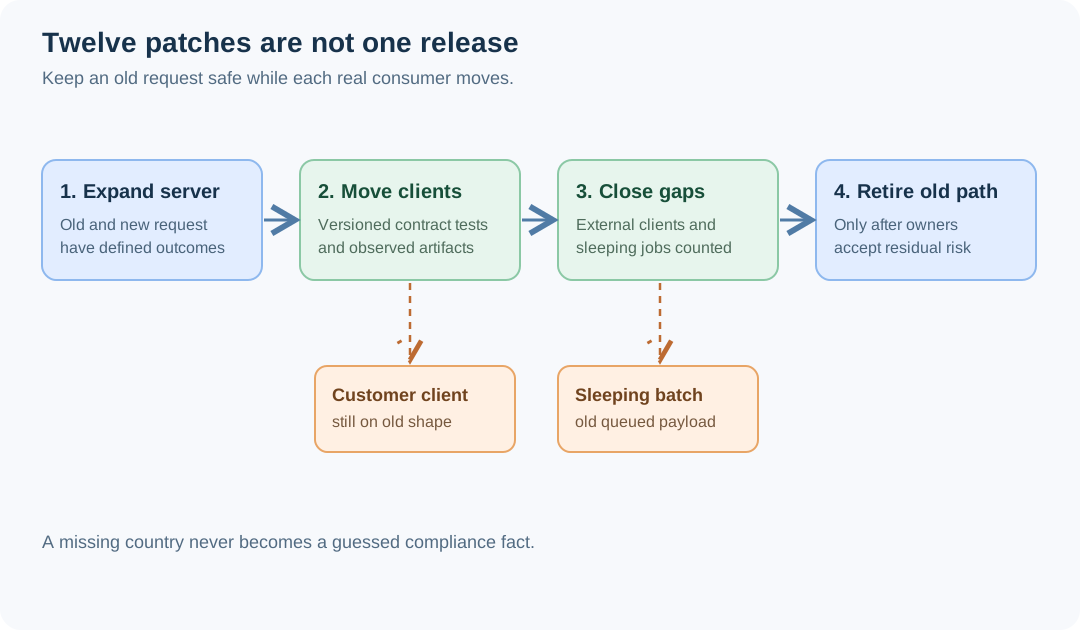
The agent can help generate patches and contract tests. I would have it attach a change ledger per consumer: repository commit, owner, generated SDK version, build artifact, deployment status, test evidence, and any external client gap. The code graph from Which code actually consumes a changed event? supplies candidates, including configuration and dynamic bindings. Can the assistant say no consumers exist? is the stricter reminder that “no consumers found” does not close an unknown external population. A source change in twelve repositories is not a twelve-service release. AWS's API deployment guidance also calls out consumer metadata and staged traffic shifting as inputs to safe change.
Now suppose two services pass their tests but one continues to send an old serialized message through a queue. The server side must decode that version when the message is consumed, perhaps days later. A request-time canary will not exercise it. Seed a queue fixture from the old producer and test it against the new consumer, with a retention window and dead-letter handling. If we cannot preserve correct behavior for the queued message, hold the release or explicitly drain and reconcile the backlog.
And if the agent's patches are good but the compliance deadline is tomorrow? I would report which callers can be migrated, which can be blocked safely, which need manual capture of country, and which are unknown. The release owner and compliance owner decide the residual exposure. The agent does not turn incomplete discovery into a confident “safe to ship.” The bar is not one magical deploy. It is that every request version has a defined, observed outcome throughout the transition.
Continue reading
Related questions
Read beyond the question
Explore more agent architecture
Follow another question in this area, or return to the full Interview Prep index.
Browse this area →