The interview question. Your orders table contains 80 million rows. An engineer adds an index on status because a dashboard frequently runs SELECT * FROM orders WHERE status = 'PAID'. Roughly 78 percent of orders are paid. PostgreSQL still prefers a sequential scan, and forcing the index makes the query slower. Explain that result. What measurements would persuade you that the index is useful for a different query?
Assume this is a conventional PostgreSQL heap table, with rows spread across many pages. Nothing is wrong with the index, and the query must actually return all matching rows. We are examining the cost of finding rows, not the accuracy of the planner's statistics. The next questions will look at ordering and planning mistakes separately.
Think first
A 100-million-row events table has an index on event_type. 85 percent of rows have event_type=CLICK. The reporting query selects the full payload of every CLICK event. Explain why the planner chooses a sequential scan, how you would validate that choice safely, and one different query shape where the index may win.
Take a few minutes to form an approach, then compare it with the worked explanation.
Check the exercise numbers
For the exercise, 100 million × 85% = 85 million full payload rows. The index still identifies an enormous heap result; that count is not an I/O or latency estimate. Compare actual page locality, buffers and result bytes before choosing a scan.
Reveal the worked explanation
An index tells you where rows are, not that reading them will be cheap
Suppose a library has 80 million cards. A catalog locates ten cards without checking every shelf. But consulting it to retrieve 62 million cards may add work.
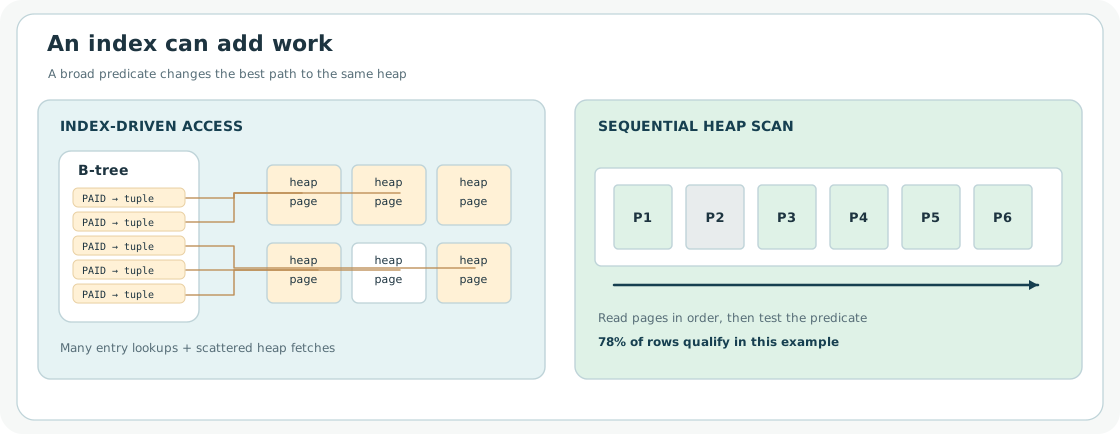
The database faces the same choice. With a B-tree index on status, it can locate index entries for PAID. But SELECT * needs columns that are stored in the heap. The index entries identify table rows, and those rows may be scattered across the file. A scan that follows many index pointers can revisit heap pages in an inconvenient order, with considerable per-row and page-access overhead.
A sequential scan reads heap pages in storage order, checks visibility and status, and returns matches. It examines rows that will not be returned, which sounds wasteful. Yet scanning many pages in a predictable order can be cheaper than finding millions of locations through an index and then visiting their table pages. PostgreSQL explicitly compares these access patterns in its EXPLAIN guide.
A sequential scan walks table pages once, while an index-driven scan can fetch matching heap rows scattered across many pages
The useful question is not whether an index exists. It is how much work the query avoids by using it.
Change the question, change the plan
For the original dashboard query, about 62.4 million of 80 million rows match. There is little filtering benefit. Now ask for an unusual state such as REQUIRES_REVIEW that appears on only 0.05 percent of orders. That is 40,000 candidates. If the heap fetches are reasonably localized or the required pages are already cached, the index may be substantially better. The direction is plausible, not a guarantee from selectivity alone.
Or ask for only ten recent rows:
SELECT id, created_at
FROM orders
WHERE status = 'PAID'
ORDER BY created_at DESC, id DESC
LIMIT 10;
Now an index ordered by the relevant fields might stop after finding ten qualifying rows rather than reading millions. Whether it does depends on the key order and predicates, which is the subject of the next lesson. The important change here is the amount of data the request actually needs.
Even returning only id instead of SELECT * changes the cost model. Narrower results save network and row materialization. A carefully designed covering index might avoid most heap visits on sufficiently stable pages. We will examine that claim in the fifth lesson rather than treating an index as automatically covering.
The number to look for is not an index hit count
Start with the actual production query, not a simplified one whose predicate is different. Use a safe replica or bounded staging dataset if executing the full query would be disruptive:
EXPLAIN (ANALYZE, BUFFERS)
SELECT * FROM orders WHERE status = 'PAID';
EXPLAIN without ANALYZE shows the proposed plan. ANALYZE executes the query and adds observed timings and row counts, so it is not a harmless dry run for an expensive statement. BUFFERS helps distinguish cached block activity from reads. The planner's estimated cost is not a millisecond figure. Compare the estimated and actual rows, actual work, and total execution time rather than reading one cost number as a latency guarantee. See the PostgreSQL execution-plan documentation.
For this example I would compare an ordinary plan with a diagnostic plan that discourages sequential scans in an isolated session. That is an investigation technique, not a recommendation to leave enable_seqscan disabled in production. Measure both with realistic cache warmth and concurrency. If you fetch 62 million rows over the application network, sending and decoding the result can dominate both database scan strategies. Measure that separately.
There may also be a middle strategy. PostgreSQL can combine an index lookup with a bitmap heap scan, organizing heap page visits rather than fetching each tuple in raw index order. A bitmap scan still reads heap pages. It is not an index-only scan, and because bitmap-driven access does not preserve index order it may require a later sort. This option matters when a meaningful but not tiny fraction of rows qualifies.
Would you keep the index?
Not on the strength of this query alone. An index has write and storage costs. Inserts and updates may need to maintain it, and its pages compete for cache. Removing it without examining other consumers could also hurt a selective operational query that uses the same field.
I would collect the important query shapes, their frequencies, rows returned, actual access paths, and index write burden. With mostly broad status queries, a single-column B-tree may not repay its maintenance cost. A partial index for a rare operational state, a composite index for a bounded ordered lookup, or a precomputed report could make more sense, depending on the workload.
The Senior-level answer is not “indexes are good for reads.” It is that an index is another route to data, and that route has its own cost. A Staff-level answer adds measurement under the real query mix and avoids adding structures whose operational expense exceeds their benefit.
We know why an index can lose to a scan. But the dashboard now asks for the latest fifty paid or refunded orders for one merchant. There is an index with all the columns. Why does the database still sort?
Go deeper
Details worth knowing when tuning this in PostgreSQL
A sequential scan, plain index scan, and bitmap heap scan are different executor nodes. The planner's estimated number of rows is the number emitted by a node, not necessarily every tuple it examined to produce them. Read the filter, index condition, actual loops, and buffer details together. PostgreSQL's cost settings such as random_page_cost are model inputs and should reflect the storage environment, but changing them globally because one plan looks odd can alter unrelated workloads.
A partial index such as CREATE INDEX ... ON orders(created_at) WHERE status = 'REQUIRES_REVIEW' can be effective when a narrow subset is queried frequently and predicates match its condition. It does not help the broad PAID query just because both mention status. A bitmap strategy is often useful between very selective index probes and large sequential scans, but its performance depends on memory, page locality, and the number of matches.
If the dashboard truly needs tens of millions of detailed rows, the architecture question may be whether it should be a synchronous request at all. A materialized aggregate or analytics path can answer a different, well-defined report without pretending an index will make a huge result cheap.
Check your reasoning
Explain the cost of using the index to locate many heap tuples versus scanning pages sequentially.
State the qualifying fraction explicitly; row count, page locality, and caching can change the access-path cost.
Explain how to compare Seq Scan, Index Scan, and Bitmap Heap Scan with observed rows and buffers.
Account for the cost of returning an enormous result rather than blaming only the database scan.
Propose a selective query or alternative data path and acknowledge index maintenance cost.
Common mistake: Assuming the optimizer is broken merely because it ignores an available index.
Read the answer explanation
A sequential scan may be faster because the index still requires a very large number of heap fetches. — When nearly all rows qualify, sequentially scanning table pages can be less expensive than walking index entries and fetching scattered tuples.
Apply it elsewhere
A vector metadata table has an index on is_active. Nearly every embedding is active. Users want an hourly export of active embeddings. How would you decide whether to use the index?
Compare your approach
Measure qualifying fraction, result bytes, heap access cost, cache effects, and export design. An index on a nearly constant flag is not automatically the best plan.
One more constraint
A selective predicate becomes common over time. What metrics would reveal when its original index stops helping?
Quick revision
An index is a lookup route, not a guarantee of fewer I/Os. For a predicate that matches most rows, finding millions of index entries and fetching their heap tuples can cost more than scanning the heap sequentially. I would measure the actual query with EXPLAIN (ANALYZE, BUFFERS) in a safe environment, look at actual rows and page activity, compare the index scan, bitmap scan, and sequential scan, and include result-transfer cost. The same index might help a rare value or a small ordered result. I would keep it only if the total read benefit justifies write, storage, and maintenance costs.