Interview question. A marketplace keeps 120 million customer profiles in a distributed key-value store. Get(userId) is fast and predictable. Product now wants a page showing all verified creators in Bengaluru, sorted by most recent activity. Someone suggests reading every customer and filtering in the application. Would you keep the key-value store, introduce another representation, or replace the database?
Assume profile lookup by ID accounts for most traffic. The new discovery page can be a minute behind profile edits, but the account authorization path cannot silently trust that delayed copy.
Think first
You operate 60 million device records accessed by device ID. Product adds “show offline sensors with battery below 10% in this building.” Choose the access path, freshness guarantee and update strategy.
Take a few minutes to form an approach, then compare it with the worked explanation.
Reveal the worked explanation
A fast lookup only proves one access pattern is fast
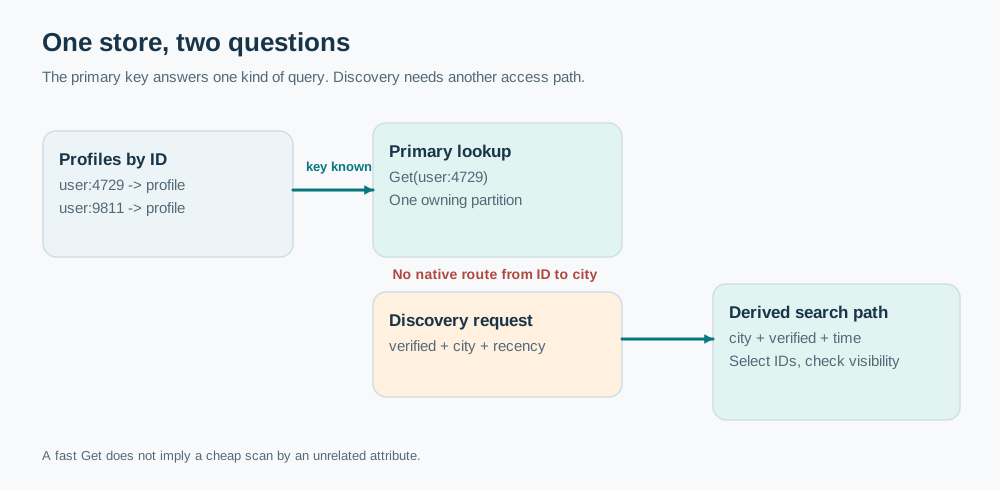
The current service has a straightforward contract: given the full key, retrieve the value. A request for user:4729 goes to the partition owning that key and reads one record. No coordinator has to search for a matching city across the whole cluster.
Now consider the new request. It does not know a user ID. It asks for a set of users sharing a property, ordered by another property. The key-value API has not suddenly acquired an efficient route from (verified, city, lastActive) to user IDs.
A scan may return the correct answer for a quiet test database. For 120 million records, it also means reading data that does not match, sending it somewhere, applying the filter and collecting results. Adding a filter expression to a scan does not necessarily spare the underlying read. DynamoDB, as one concrete key-value product, documents that scan filtering happens after items are read and still consumes read capacity for scanned items. DynamoDB Scan
Profile lookups by user ID use key placement, while a discovery query needs a separate access path.
The first good interview question is not “Which NoSQL database is fastest?” It is “Which requests must be cheap, and what information does each request already know?”
Give the discovery query its own route
I would keep the authoritative profile record keyed by user ID for this scenario. Then I would ask what kind of discovery functionality actually matters. If the filters are stable and limited, a purpose-built secondary index may be sufficient. If users need evolving filters, text relevance and facets, a separate search representation might be easier to operate than manufacturing a growing family of manual key prefixes.
A possible secondary access path is (city, verified, lastActive, userId). The exact ordering and physical representation depend on the database. It is not a universal schema that every key-value engine can query efficiently.
For a datastore such as DynamoDB, a global secondary index can use different key attributes from the base table. It is maintained asynchronously and permits eventually consistent reads. A local secondary index has different key restrictions and read behavior. Those differences are product contracts, not just vocabulary. DynamoDB secondary indexes
For the discovery page, an eventually consistent index might be acceptable. A creator who verifies a profile may appear in results slightly later. But a stale index must not authorize access to private profile fields. We should fetch current permitted details or apply an authorization decision at a trusted boundary.
This separation makes the architecture more honest. The profile is the source of truth. Discovery is a derived read model optimized for a different question.
Check what happens when the query grows
Suppose the page initially shows verified creators in one city. A month later product wants topic filters, follower-count ranges and full-text matching. An index optimized for the first request may not give you a cheap query for the second.
At this point, compare two costs. One is maintaining additional representations every time a profile changes. The other is repeatedly scanning most of the corpus at request time. The right choice depends on update frequency, read frequency, freshness and operational complexity.
Even a secondary index has its own workload. A city such as Bengaluru might have millions of eligible users, and a sort by recent activity may concentrate writes in its leading range. Partition placement and a query's sort shape still matter. We must not assume the word “index” eliminates hot partitions or write amplification.
I would put numbers on the new path: expected search requests per second, candidate-set sizes, pagination depth, acceptable staleness, and update rate. A million profiles changing activity status every few seconds could make a constantly reordered index expensive. We might instead rank from a periodic snapshot or separate coarse freshness buckets.
That is a design decision driven by the query contract rather than by a database family label.
When would I change the primary store?
Keeping the key-value primary is not a religious preference. If the application evolves so that nearly every operation involves multi-record joins, flexible filtering and strong cross-record constraints, a relational or document database with appropriate indexing may reduce complexity. Conversely, high-rate simple point reads and conditional per-item updates can remain a very good match for a key-value service.
I would also ask about atomic operations. An external index cannot be treated as the authority for uniqueness or checkout correctness merely because it can find a matching record. A query returning no result from an eventually consistent index is not proof that no matching authoritative record exists.
The simplest acceptable architecture might be two representations and one deliberate freshness contract. It need not be seven microservices, a general-purpose search platform and a streaming cluster on day one.
If the interviewer says the new filter will be used twice a day by an internal analyst, my answer changes. A bounded offline scan may be cheaper than maintaining a live index. If it becomes a high-traffic customer-facing page, the same scan is no longer a sensible hot-path design.
The interesting consequence is that an access path is part of the product contract. Once another team depends on searching profiles by an attribute, that attribute can change. A phone number is an especially awkward example because it also has uniqueness and ownership implications.
Go deeper
Optional depth: index backfills and consistent cutover
Adding a secondary access path to an existing large dataset requires a bootstrap and a way to account for changes happening during that bootstrap. A naive full scan followed by enabling the index can miss updates that occurred earlier in the scan. A managed database may provide an index lifecycle, whereas a manually maintained search projection needs snapshot boundaries, change capture, deduplication, gap detection, and cutover checks. The solution depends on the source's guarantees. Do not assume that a table-wide consistent snapshot is provided by requesting individually consistent items. DynamoDB explicitly documents that strongly consistent Scan does not provide snapshot isolation across the scan. DynamoDB Scan API
Check your reasoning
State the query attributes already known for each access pattern.
Explain Scan cost and the capacity consequences of post-read filtering.
Select an appropriate derived access path and its freshness contract.
Separate discovery accuracy from authorization authority.
Common mistake: A fast GetItem proves arbitrary filtering will also be fast.
Read the answer explanation
A new indexed route can serve a stable high-volume filter, at a write and freshness cost — The access path, not the family name, determines query efficiency. Derived representations have maintenance and correctness costs.
Apply it elsewhere
An API gateway stores tokens by token ID but security needs “revoke all tokens for one user.” What second access pattern must be modeled?
Compare your approach
Identify the full key on the original read path. Reject a large hot-path scan without capacity evidence. Choose a suitable derived access path based on access patterns. State the authority and consistency boundaries. Explain migration, cost and growth triggers.
One more constraint
A query filter returns 100 rows from a 10-million-row Scan. Does the small result guarantee a cheap scan? Why?
Quick revision
A key-value database can be extremely efficient when callers know the key. A query by an unindexed attribute is another access pattern, often requiring a scan. Keep the primary path if it still fits, and introduce a deliberately maintained alternate index or read model when the second query justifies it. State its freshness, write costs and authorization limits rather than pretending that a fast Get means every future query will be fast.