Build a new representation without changing the old one
First create a separate destination index with the new mapping, analyzers, shard arrangement, lifecycle settings and capacity. Reindexing data does not automatically copy all of those settings. Analyzer changes typically require rebuilding stored tokens.
Choose an authoritative data source. If product data comes from a transactional catalog database, prefer a consistent snapshot of that catalog plus an ordered change feed. If Elasticsearch is the only copy, account for its version and deletion semantics. A catalog plus CDC provides a clearer durable source sequence.
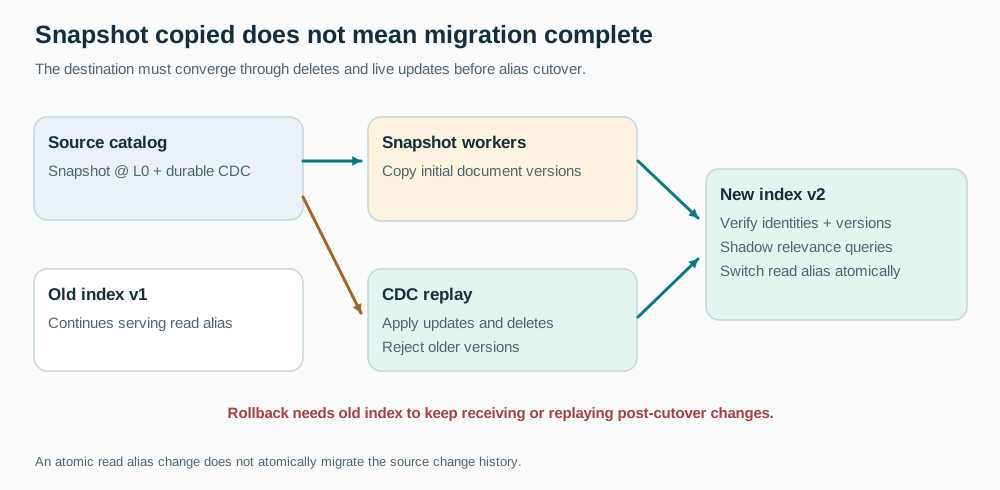
At snapshot time, record a source high-watermark, say position L0, using a method that couples snapshot consistency and change capture without gaps. Copy every current product as of that snapshot. At the same time, preserve later changes beyond L0 for replay into the destination. The snapshot may take hours. Retain change history long enough and reject stale writes by document version.
The deletion that a naive reindex misses
Suppose the snapshot contains product 88 at version 40. During copying, a customer removes the listing at version 41. If the new index later receives the old snapshot document but never receives the delete, the deleted listing returns after cutover. The change history is incomplete.
Even if we capture the delete, ordering matters. If version 41 is applied before a slow snapshot worker writes version 40, an unguarded overwrite can resurrect the product. Use a version-aware indexing protocol appropriate to the source and destination, and keep sufficient deletion markers to reject late old writes. With out-of-order events across products, a global ordering may be unnecessary, but the sequence for each product must preserve or enforce its latest authoritative version. Do not claim Elasticsearch external versioning alone solves retention of all tombstones forever. Define the late-write window and the source recovery mechanism.
Another trap is treating two independent writes as a transaction. Dual-writing every live change to both old and new indices introduces partial successes, timeouts and differences in refresh timing. Dual writes need durable retry and reconciliation. Replayable change streams are easier to reason about.
Cutover is a protocol, not an API call
When the destination snapshot is complete and its replay stream is caught up, measure the lag from source commit to destination visibility. Check counts by partition or tenant, sample document versions, missing deletes, analyzer behavior and relevance quality. Counts alone are weak because an extra stale item and a missing current item can cancel numerically. Perform source-versus-index reconciliation on identities and versions.
Now prepare the read cutover. Elasticsearch aliases support changing index targets through the aliases API. A single atomic alias update can move the application's read name from the old index to the new one. But the API does not automatically route independent application writers to the correct index or drain CDC work. If writers use a different write alias or a hard-coded physical index, coordinate those paths separately. Account for in-flight requests.
A safe plan might keep indexing both versions for a limited compatibility window while only the read alias moves. Verify old-index writers cannot silently become authoritative. If the new index fails after cutover, rollback means more than pointing reads back. The old index must still have complete updates since the switch, or we must replay them into it before using it again. Otherwise rollback swaps one incomplete dataset for another.
Test the migration under concurrent creates, updates, deletes and updates to documents that share analyzers. Induce an indexer restart between checkpoint and acknowledgment. Verify retries converge on the correct product version and that the source log can recover after a prolonged pause. Check source retention before beginning a multi-day copy, not after it exhausts history.
Decide what counts as success
The new index can be functionally different by design. Its analyzer may change match results, score distributions and tokenization in ways that are not detectable by document count. Shadow a representative set of user queries against both versions, compare eligible result sets and relevance metrics, and have owners approve intentional changes. Privacy filters and deletions deserve stricter tests than ranking. A product that became restricted must not reappear simply because the migration got its row count right.
I'd also keep the old index for a bounded, costed fallback period with explicit criteria for removal. Monitor index refresh lag, source-to-destination version lag, stale-result rates, error budget, alias targets and unexpected writes to the retiring index. Rollback depends on recoverable history.
The interview lesson is atomic routing does not imply atomic data migration. A trustworthy reindex couples a consistent snapshot with complete change capture, ordered or version-safe application, validation of deletions and an operationally sound cutover. If those conditions hold, the alias switch becomes the uninteresting part of the design.