A messaging product stores conversations, participants and messages. It needs to show the newest 30 messages for a conversation, then list a user's conversations by recent activity. A team models normalized tables and assumes Cassandra will join them on every request. Design the access paths, choose partition and clustering keys, and explain what happens when one conversation receives millions of messages.
Assume the main workload is predictable and high volume. The product needs pagination by conversation and user. Cross-conversation analytics can use an independent analytical path rather than run unrestricted joins on the serving cluster.
Think first
Model a sensor service in Cassandra. It needs the last 100 readings per device and the most recent readings for all devices in a building. Choose tables, partition keys, clustering keys and a size-bounding strategy.
Take a few minutes to form an approach, then compare it with the worked explanation.
Reveal the worked explanation
Start from the read, not the entity diagram
A relational designer might naturally create conversations, participants and messages, with foreign keys and joins for each screen. That isn't how Cassandra's fast-path data model is intended to work. Cassandra's documentation explicitly describes query-driven modeling, where tables are arranged around specific reads and data may be copied into more than one table. Cassandra modeling introduction
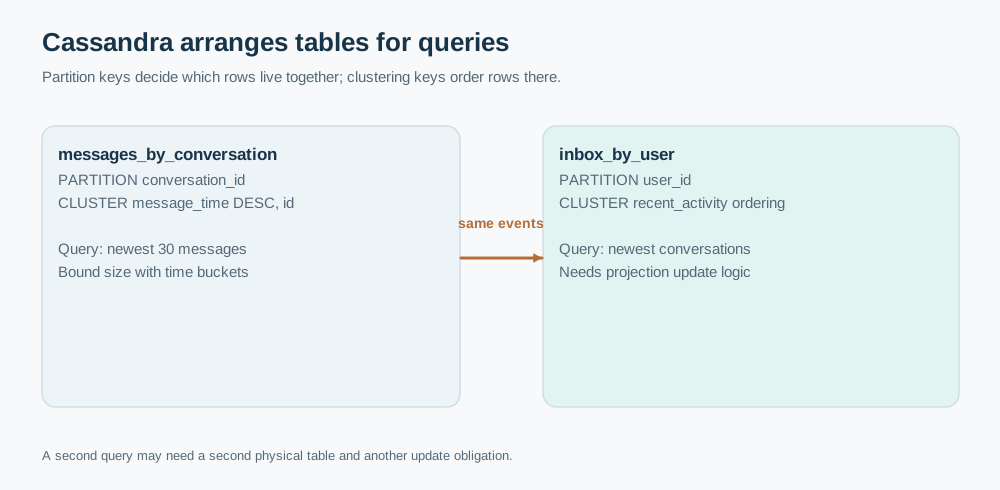
For “newest messages in conversation c91,” a sensible query table could use conversation ID as its partition key and message time plus a tie-breaking message ID as clustering keys.
That gives the query a known partition to visit and a useful order within it. Cassandra's clustering keys define ordered arrangement inside a partition. The primary-key declaration should follow the exact CQL grammar for the intended table.
Conversation-message and user-inbox tables serve different queries with independent partition and clustering keys.
But “list the conversations this user participated in, by recent activity” starts from user ID, not conversation ID. A second table such as inbox_by_user can place all relevant conversation-summary rows under a user key, clustered by a suitable recency or bucket representation.
That is not gratuitous duplication. It is the physical consequence of supporting two different efficient query shapes.
A partition key decides both locality and the limit
The first query is excellent while conversations remain within manageable partitions. It becomes problematic if one group receives tens of millions of messages. Partition size, repair cost, tombstones and hot writes can all dominate the original convenience.
I would introduce a bounded time bucket or another partition segment:
Now the latest page normally visits the current bucket. Older pages can move backward through buckets. A conversation spanning years requires more than one partition lookup, which is an intentional cost of bounding partition size.
Don't pretend a one-month bucket is universally correct. A quiet conversation might never fill it, while an extremely active group can overflow its target in days. Bucket duration and maximum partition size need measured throughput, message sizes, retention and update behavior. High-volume conversations may need finer buckets or another split mechanism.
Cassandra's logical data modeling documentation emphasizes choosing partition keys and clustering columns based on the query and expected per-partition data volume. Cassandra logical modeling
Distributing writes across keys can conflict with keeping a range query local. In Cassandra, that trade-off appears directly in the relationship between partition keys, clustering order, and multiple tables designed around predetermined queries.
What about the user's inbox order?
Consider user 4729, who participates in 500 conversations. A message arrives in conversation c91. The product wants c91 to move to the top of that user's inbox.
A table keyed only by (user_id, conversation_id) supports finding a conversation for one user, but it does not automatically support listing all conversations in last-active order. A table clustered by activity time may make that read efficient, but updating a conversation's position can involve a new clustering entry and retirement of an old one. This is not a free in-place sort operation.
One strategy maintains one inbox item per user-conversation under a stable identity and uses a separate ordered summary representation updated asynchronously. Another stores immutable activity events and derives a current inbox with an explicit freshness target. The choice depends on the number of conversations, unread-count accuracy, and tolerance for temporary reordering.
Ask product which parts need strict correctness. Duplicate conversation cards can be annoying and require cleanup. But a new message disappearing from the actual conversation history is more serious than a stale inbox sort order. Those may justify different write and repair contracts.
Cassandra's wide-column model is not a columnar analytics engine
The term wide-column can mislead candidates. Cassandra groups columns and rows into partitions for key-based access and clustering-order scans. That is not the same as a columnar analytical format which stores the same field's values together to scan a few selected columns across billions of rows.
If an interviewer asks for a query that groups every user's messages by language and performs ad hoc joins, I would not force it through the serving tables. I would supply a separate analytical representation with a suitable ingestion and freshness policy.
Every extra query table also increases write amplification and consistency obligations. Message state copied into messages_by_conversation and inbox_by_user must be updated through a defined protocol. We haven't solved that problem by drawing two tables, only made the read paths explicit.
How I would defend the model in an interview
I would show three real application requests and the exact partition and clustering columns that make each cheap. I would estimate the largest partition over retention time, plan pagination boundaries, and identify where denormalization can lag.
Then I would ask what happens if a new query arrives six months later. In a query-driven system, a new query pattern may require another table or a deliberately different data store. Cassandra's model can be powerful for stable high-throughput access, but the team has to own the maintenance work for each extra representation.
The next interview question is the part candidates often skip: if we deliberately duplicate data across three tables, what does a multi-partition batch actually guarantee when one write or coordinator fails?
Go deeper
Optional depth: clustering order and pagination
A clustering column defines sort order within its partition. If message timestamps can collide or arrive out of order, include a stable tie-breaker and define the desired semantics. A cursor should carry enough information to continue within the same query shape, potentially including the bucket and clustering position. Avoid assuming an ordering based on client wall clocks represents causal delivery order. Also distinguish logical deletes and TTLs from immediate physical reclamation, because tombstones affect reads and compaction.
Check your reasoning
Write concrete queries before selecting the Cassandra schema.
Explain partition and clustering keys for each query.
Bound very large or hot partitions.
Recognize that a second table creates a consistency obligation.
Distinguish wide-column from analytical columnar storage.
Common mistake: Adding a regular column to a Cassandra row creates a new efficient cross-partition query.
Read the answer explanation
Choose Cassandra table layouts based on query keys and order — Cassandra organizes data around keyed partitions and clustering. Different query keys often require deliberately denormalized tables.
Apply it elsewhere
Model a support ticket history where agents need newest updates per ticket and managers need newest open tickets by team. Which queries deserve distinct physical access paths?
Compare your approach
Begin with exact queries. Name partition keys and clustering order. Estimate partition growth and hot keys. Explain additional query tables and their maintenance. Reject general-purpose cross-table joins on a Cassandra serving path.
One more constraint
Why does adding `building_id` to the message value not automatically make the query “all messages in building B in time order” cheap?
Quick revision
Cassandra data modeling begins with the query. Partition keys define where related rows live, while clustering keys define useful ordering within that partition. A second query beginning with a different key may need another denormalized table. Keep partitions bounded, make pagination intentional, and accept that duplicated read models need their own update and consistency protocol. Wide-column serving is not the same as analytical columnar storage.