An online ticketing system rolls out a new seat-allocation algorithm to 5% of tenants. Requests cross Java, Go and browser clients. Design deterministic assignment, rollout observability, mid-transaction consistency, kill-switch behavior and fail-safe handling when the flag SDK cannot update.
Capacity, Isolation & Operations · Staff
The feature flag says off. Why are some customers still seeing the feature?
The Config Changed. Who Told the Fleet? · Part 4 of 6 · 6 min read
Read the worked explanation ↓Think first
An online ticketing system rolls out a new seat-allocation algorithm to 5% of tenants. Requests cross Java, Go and browser clients. Design deterministic assignment, rollout observability, mid-transaction consistency, kill-switch behavior and fail-safe handling when the flag SDK cannot update.
Take a few minutes to form an approach, then compare it with the worked explanation.
Reveal the worked explanation
Interview question. A company uses feature flags in 1,000 services for gradual releases and emergency kill switches. A flag is disabled globally at 14:00, yet some users see the new checkout path for another ten minutes. Design local evaluation, consistent rollout assignment, update propagation, safe fallback, and evidence that a kill switch took effect.
A product manager looks at the control plane and sees new_checkout=false. The incident channel, however, contains screenshots of the new flow. One engineer concludes the flag system is inconsistent. Another proposes calling the flag server on every request so the answer is always current. Both reactions skip an important question: what did the flag control plane promise about when a changed value becomes active in each service, browser session, or request?
Feature flags are configuration with a decision function attached. A Boolean key alone is easy to store. The harder part is evaluating rules over user, tenant, region, application version and rollout percentage while keeping the decision stable enough for a customer journey. A request must be able to explain which ruleset was evaluated, which context fields were used, and which variant was returned. Otherwise a central dashboard and a user's observed behavior cannot be compared meaningfully.
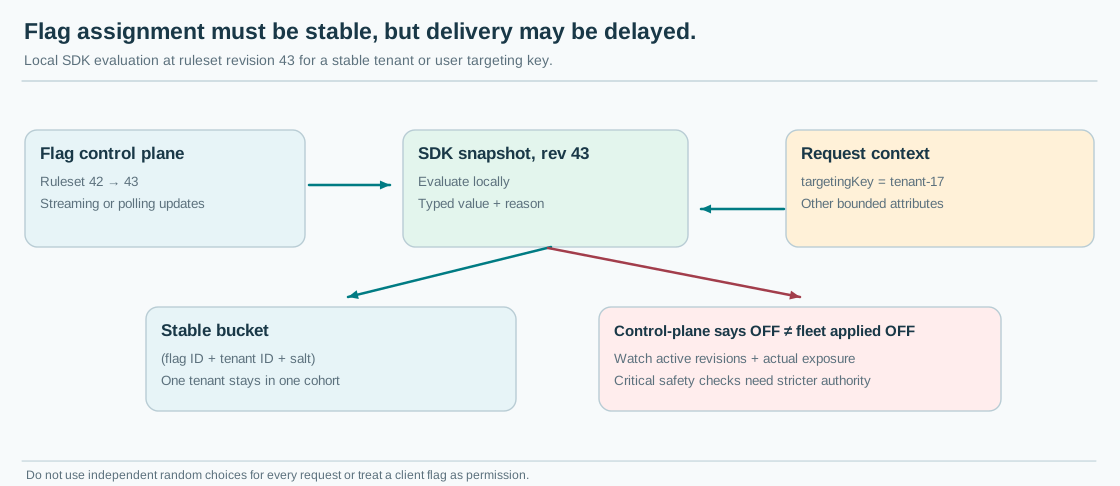
A low-latency implementation usually evaluates flags locally in the service or application using a cached, versioned ruleset. A streaming subscriber or polling agent updates that ruleset asynchronously. The request supplies an evaluation context, such as tenant identity, customer identity or country, and receives a typed value plus useful evaluation metadata. OpenFeature defines a provider-neutral evaluation API and an evaluation context with a targeting key. It does not, by itself, provide a centralized flag distribution service or guarantee one propagation time across implementations. Keep the contract of your chosen provider explicit.
Now consider a 10% rollout. A tempting implementation is random() < 0.1 on every request. That means a user may see the new checkout for one click and the old checkout for the next. Instead compute a stable bucket from a canonical targeting key, flag identifier and rollout salt, then compare the bucket with the allocated range. For example, hash (flagId, tenantId) when an entire tenant must stay together, or (flagId, userId) for user-level assignment. The exact hash and normalization must be consistent across SDK languages. Changing salts or targeting-key semantics can reassign everyone, even if the percentage stays at 10%.
Sticky rollout assignment is not the same as cross-service consistency. Suppose the gateway has ruleset 41 and the payment service has ruleset 42. The gateway evaluates checkout variant A, but payment independently evaluates variant B. If those variants have incompatible request formats, one request can fail even though both evaluations are internally correct. For cross-service protocols, prefer backward-compatible behavior independent of flag state. Where the same decision must be consistent for one transaction, evaluate once at a trusted boundary and propagate the decision and experiment version, or enforce a compatible operation contract between components. Do not treat a client-provided flag as an authorization grant.
Why was the flag still on ten minutes after disablement? Trace the version timeline. At 14:00 revision 43 is approved. Some SDKs receive the stream update immediately, others have a failed subscription and poll every fifteen minutes. A mobile client has a cached assignment for the session. An application worker may have swapped its ruleset but an in-flight request captured revision 42 at request start. These are distinct causes. Record the active revision with evaluation results and expose age of the locally applied ruleset. Count the fraction of healthy instances using the new revision, not merely successful pushes to the distributor.
An emergency kill switch needs a tighter contract than an ordinary visual experiment. If a new recommendation panel is broken, a few minutes of stale enablement may be acceptable. If the flag controls whether a payment may be authorized, a stale true might violate a security or financial constraint. Use an independent authoritative safety control for critical approvals, or define a short-validity policy that fails closed once its freshness deadline passes. Calling the flag system itself a kill switch does not make propagation instantaneous. Prove the end-to-end bound, including edge caches, SDK reconnects and process-level adoption.
Missing evaluation data creates another failure. Suppose 20% rollout is defined per tenant, but a downstream background job lacks tenantId. Silently hashing an empty string can place all such jobs in one bucket. Using a random UUID on each call makes results unstable. Define an explicit fallback value, log a bounded reason code, and prevent missing-context paths from unintentionally enabling sensitive behavior. Avoid logging raw user attributes in evaluation telemetry. The right targeting key can often be a stable pseudonymous identifier rather than personal data.
Now design a rollout timeline. Publish the rule as immutable revision 42, check schema and targeting syntax, evaluate it in a shadow mode against sampled real contexts, then activate it for a small cohort. Observe technical and business outcomes, including checkout completion, user-visible errors, and variant exposure counts. Increase only after adequate evidence. When a change is paused, do not automatically sweep old variant state out of long-running jobs that already committed to that behavior. Decide whether active sessions should finish on the original variant and when a hard stop overrides them.
Finally run a kill-switch drill. Turn off the flag, partition 10% of SDK subscribers, crash one local cache, and generate a mixed-version checkout request. Verify the stated propagation bound or permitted degraded behavior, detect stale revisions, and prevent incompatible evaluations from corrupting payment state. A Staff-level answer distinguishes assignment, evaluation, delivery and authority. The dashboard showing off is only the beginning of the state transition, not proof that customers have stopped seeing the feature.
Go deeper
Percentage assignment often hashes a normalized targeting key into a fixed bucket space. Changes to targeting scope, salt, hash, rule order or evaluator implementation are migration events. Monitor both configuration revision and evaluated variant because a revision can change rule ordering while retaining the same Boolean result for many users. OpenFeature evaluation details can help explain a returned value, but actual provider capabilities vary. Strongly security-sensitive decisions should be designed as authorization policy with explicit freshness rather than relying solely on an experimentation flag.
Check your reasoning
- Specify local provider-backed typed evaluation and propagation of revisioned rule snapshots.
- Derive stable percentage cohorts from an appropriate targeting key and consistent hashing semantics.
- Handle mixed ruleset versions across services without assuming all evaluations are simultaneous.
- Separate experimentation defaults from safety-critical authorization and kill-switch contracts.
- Measure real customer exposure, stale SDK age, and privacy-conscious evaluation reasons.
Common mistake: A management dashboard toggled to off proves no application still serves the feature.
Read the answer explanation
Track applied ruleset revisions and actual exposure while using stable targeting and defined kill-switch staleness. — Flag control-plane state is not automatically the active fleet state. Local evaluation needs stable cohorts and an explicit freshness contract.
Apply it elsewhere
A machine-learning model variant is assigned per device, but users switch devices mid-session. Choose the correct identity and consistency scope for model assignment versus payment authorization.
Compare your approach
Describe versioned local flag evaluation, choose stable targeting identities, handle cross-service inconsistent versions, differentiate rollout from critical kill-switch guarantees, and measure applied revision and actual exposure without collecting unnecessary personal data.
One more constraint
Does setting a flag to false in the management UI prove every service instance is evaluating false at that moment?
Quick revision
A feature flag is a versioned ruleset evaluated against context, not merely a Boolean in a database. Keep evaluation fast with local caches, make percentage cohorts deterministic through stable targeting keys, and track the applied revision. Cross-service flag versions can differ, so transaction protocols must remain compatible or pass a trusted evaluated decision. A management UI value is not proof of fleet adoption. Critical kill switches need explicit propagation and freshness guarantees, with authoritative controls for security-sensitive outcomes.
References
- Evaluation context and targeting keys · OpenFeature
- Flag evaluation API and defaults · OpenFeature
- Safe configuration change application · Google SRE