Start with the operations, not the brand names
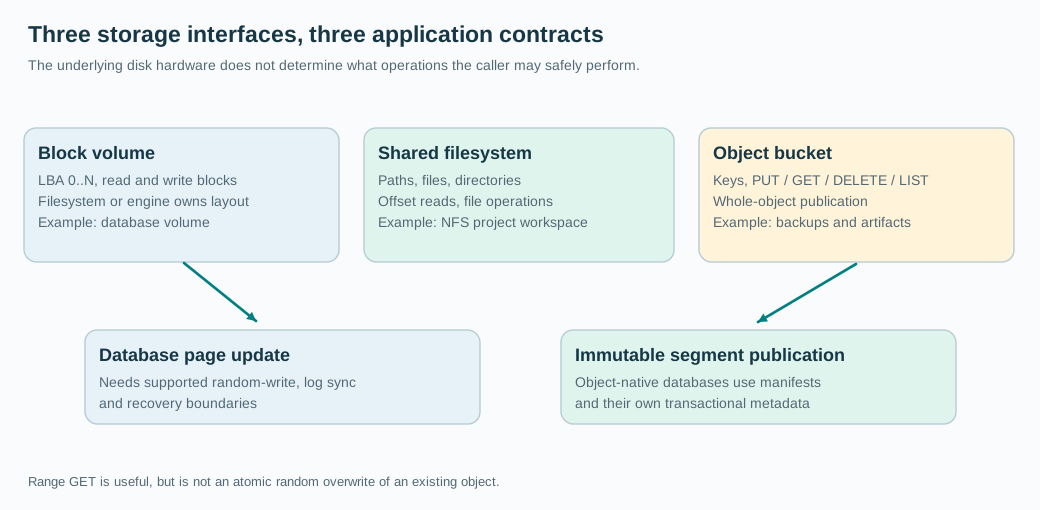
A block device presents logical blocks at addresses. An operating system can build ext4 or XFS on top, and the database can open files on that filesystem. The block service need not know that an address contains a B-tree page, journal record, or directory inode. A cloud volume such as EBS fits this category. Block storage can be network-attached while still exposing disk-like semantics. That doesn't eliminate latency or durability questions, but it gives the OS a suitable primitive.
A file system exposes named files, paths, directories, permissions, reads at offsets, and some form of shared access or locking contract. NFS-backed shared storage such as EFS is useful when several application instances need a common directory tree. Its performance and consistency details matter. A file interface does not promise that every distributed database can safely share one file, because database engines may require exclusive writers, specific locking guarantees, or coordinated journal ownership.
An object service exposes a bucket, an object key, metadata, and operations such as PUT, GET, DELETE, and LIST. It is excellent for immutable images, model artifacts, exports, logs packaged as objects, and backups. Object metadata, lifecycle policy, versioning, and access control can be managed separately from an application's file layout. The tradeoff is that updating a 4 KB section is not the same native operation as a database page write.
A database's IO contract is surprisingly specific
Suppose a database modifies three random pages in a large index and commits one transaction. With a suitable filesystem and underlying block volume, it writes a log record, waits for the required durable acknowledgment, and eventually flushes the dirty pages. The engine controls page addresses and recovery order. In a naive object-backed implementation, each changed page might require fetching and publishing an entire large object. Even if the provider supports efficient ranged reads, those do not supply arbitrary atomic ranged overwrites.
You can build a database over object storage, but that is a different architecture. A cloud-native engine may write immutable segments to objects, maintain a separately coordinated manifest, use local SSD as a cache, and commit through a metadata transaction service. It is not simply taking a conventional database executable and changing a filesystem path to s3://bucket/index.db. The transactional state machine must understand the object API.
This is the first distinction an interviewer should hear. Object storage is not unsuitable for databases in general. Its mutation and publication contract is different from a disk interface. Systems designed around immutable segments or log-structured files can use it effectively, but their metadata, durability, and cache strategies are part of the database design.
Decide using four workload questions
First, what is the mutation granularity? Small random overwrites favor block-oriented storage with a database-managed layout. Whole-object replacement favors objects. Second, what is the namespace? Several tools that need ordinary file paths might benefit from a shared file system, while a service uploading signed, immutable assets benefits from object keys.
Third, who coordinates writers? A shared file path is not a transaction manager. A last-writer-wins object overwrite is not equivalent to a row lock or compare-and-swap on multiple database records. The database needs an authoritative ownership and conflict protocol regardless of where bytes live.
Fourth, what is the failure contract? A successful object PUT can provide strong per-object visibility, while the service still offers no general atomic transaction across multiple object keys. A successful filesystem write() can leave data in volatile cache until a synchronization boundary. Neither interface substitutes for understanding the exact acknowledgment and crash semantics.
For a concrete design, I would place a conventional relational database's data files on a supported filesystem over persistent block volumes, keep object storage for backups, immutable exports, and older large artifacts, and use a shared file service for workflows that genuinely require a shared directory namespace. I'd validate this with a trace of actual IO: random read/write size, sync frequency, metadata operations, object count, read amplification, and the cost of restoration.
In the interview, the strongest answer isn't a memorized table comparing S3, EBS, and EFS. It's the ability to inspect an application's required operations and notice where an apparently cheaper storage interface changes the correctness contract. Sometimes the right solution is to redesign the application around immutable objects. Other times the right decision is simply to keep the database on a disk-like interface rather than pretending the interfaces are interchangeable.