Interview question. A Kafka partition contains parcel-state events. The consumer applies changes in order for each parcel. At 09:13, a record cannot be decoded because it was published using an unsupported schema. The consumer retries that record indefinitely. Later events for unrelated parcels are valid, but the group appears stuck. Do you skip the bad record, send it to a dead-letter topic, or halt processing?
Assume the source record remains in the broker under the configured retention policy. The processing system can identify the record's original topic, partition and offset even if application deserialization fails. We must not invent a recovered business value when the payload is unreadable. For the per-parcel lane design below, assume the parcel identity and version are readable from validated envelope metadata even when the value cannot be decoded. If that identity cannot be established, pause the partition or a safely broader dependency scope rather than guessing which key can proceed.
Think first
Parcel p42 version 7 cannot be decoded. Version 8 depends on the previous transition, while p91 versions in the same Kafka partition are independent. Design retry, quarantine, progress and redrive behavior with a legitimate production deadline. State exactly which Kafka offset may be committed and whether that commit means completed effects or only durable capture.
Take a few minutes to form an approach, then compare it with the worked explanation.
Reveal the worked explanation
The first decision is not a retry duration
Before picking a backoff, determine whether the error is transient or deterministic. If the downstream database is temporarily unavailable, retries can be useful. If the payload has an unsupported schema ID, retrying the same bytes with the same code every second will not make them decodable.
An infinite retry loop turns one invalid record into a permanent availability decision for that partition. It can also waste broker fetches, worker CPU and operator attention. But skipping the event immediately can be equally dangerous if later records depend on it.
The question is: what may safely proceed while this event is unresolved?
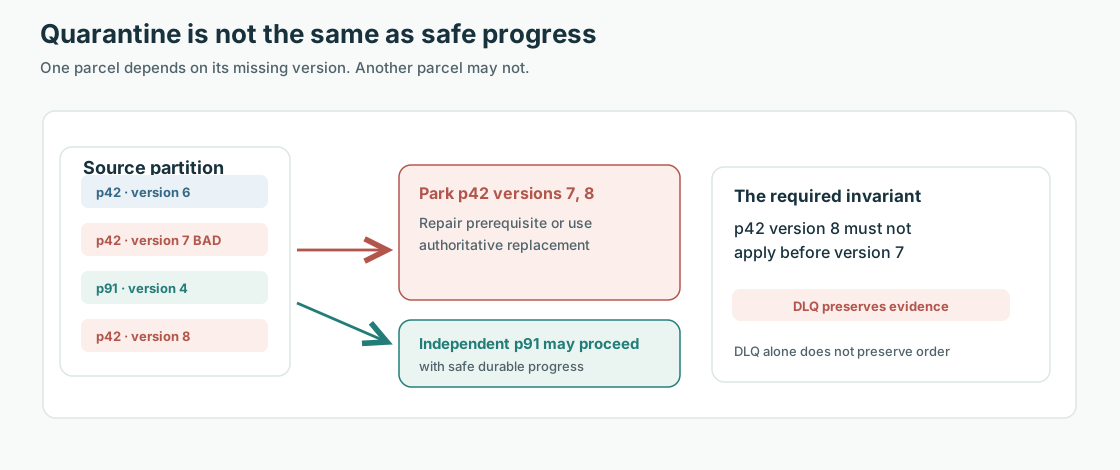
A poison event blocks a parcel's ordered lane while independent parcels may continue through separately tracked lanes
Suppose parcel p42 has version 7 at the bad record, followed by version 8 containing a relative update such as "advance status from loaded to dispatched." Applying version 8 without knowing what version 7 changed could violate the state machine. Quarantining version 7 does not mean that version 8 has become safe.
Now consider parcel p91, whose events are independent of p42. The product may allow them to continue even while p42 is paused. That gives us a narrower failure boundary than blocking every parcel on the same Kafka partition. The system must still preserve correct progress and recovery behavior for both lanes.
Give an unrecoverable record a durable outcome
For a first implementation where correctness matters more than throughput, I would pause progress on the affected partition, store the failure evidence, alert an owner, and repair the decoder or publish an authorized correction. Processing resumes only when the missing transition is resolved. This is operationally expensive but easy to reason about.
If the business allows unaffected parcels to continue, build explicit per-parcel work lanes or another partition-independent state machine. Park p42 and every later dependent p42 event. Continue p91 only if its outcome is durably recorded and the consumer can recover it without skipping unresolved earlier work after a crash.
A dead-letter topic is useful for preserving the original record, schema information, failure reason, time, processing identity and redrive context. Confluent's Kafka Streams exception guidance discusses failure, skip and quarantine approaches. It does not make any of them universally correct for ordered business effects.
Crucially, publish to DLQ and commit the original offset are two separate actions unless a supported transactional boundary links them. For Kafka-to-Kafka processing, a suitable Kafka transaction can combine the output record and consumed offset under its guarantees. An external database, email provider, or human repair workflow needs its own durable protocol. Otherwise a crash between these actions may create duplicate quarantine entries or silently lose a record if progress is advanced prematurely.
Stable original event identity makes the quarantine and repair workflow easier to reconcile. A dead-letter topic is not an unattended graveyard that satisfies a delivery guarantee merely by receiving a record.
There are two distinct progress models. With completed-prefix tracking, commit only the next offset after a contiguous prefix whose outcomes are durable; replayed independent work must be idempotent. Alternatively, broker progress can acknowledge a durable handoff of every skipped or unfinished record into a recoverable inbox or quarantine workflow, with an atomic or safely replayable checkpoint protocol. That second model does not claim the business transitions are complete. For a transactional Kafka quarantine, readers must use read_committed when they rely on aborted output records remaining invisible. A Kafka transaction does not include an external database mutation.
A skip policy is a product decision
Some event types may be safely dropped after a bounded attempt because the next event is an authoritative full snapshot. For example, a location observation from five seconds ago might be obsolete after a new full location snapshot arrives. Even then, audit and data-completeness contracts may require tracking the omission.
Other event types are transitions, payments, balances, or inventory movements. A skipped delta can corrupt every following value. For those, quarantine blocks the dependent sequence until the gap is repaired or the source of truth issues a state replacement with explicit authority.
I would write the allowed responses by event type, rather than having one global maxRetries=5 then skip rule. That is how the system gets both availability and truthful ordering contracts.
For deterministic schema errors, record the incompatible schema ID and affected producers, then correct the deployment contract. The immediate rollback might be the producer, the consumer, or a compatibility bridge. A large DLQ rate after deployment is itself a release signal. Restarting consumers does not solve a producer that continues to emit invalid payloads.
Make redrive safe, not just possible
A repaired event should re-enter the correct logical sequence. If the consumer already moved beyond the original offset for unrelated keys, redrive into the head of a topic does not recreate its old position. The parked parcel state needs a pending version and an ordered resume protocol. A handler should reject conflicting replacements that reuse an event ID for a different meaning without explicit correction metadata.
Operators also need an audit trail: who quarantined it, why, whether it blocked a parcel, which repair was applied, and what the final consumer state became. A dashboard saying "DLQ count dropped to zero" says little if the main projection still has gaps.
The policy follows dependencies. Diagnose the error, preserve evidence, prevent unsafe transitions, and isolate genuinely independent work. A DLQ is one tool here, not the entire design.
A later incident raises a different issue. The consumer was offline long enough that the event no longer exists in Kafka. There is nothing left to quarantine or retry.
Go deeper
Do not use a raw seek to jump past the bad offset and then immediately commit a later offset unless all skipped or later work has a deliberate, durable status. Per-key concurrency inside a partition needs completed-prefix tracking and recovery of in-flight lanes. Some frameworks provide retry topics or native dead-letter facilities, but they do not infer the application's invariants. Ensure that schema registries and consumer compatibility tests exercise mixed-version deployment, including bytes an old consumer genuinely cannot parse.
Check your reasoning
Separate deterministic schema incompatibility from transient downstream failure and bound repeated attempts.
Preserve the original bytes, event ID, topic-partition-offset, schema and failure context in a durable quarantine path.
Do not apply dependent p42 version 8 while version 7 remains unknown.
Allow unrelated parcels to proceed only with safe durable completed-progress tracking and rebalance recovery.
Explain why publishing to a DLQ and advancing progress need a coherent failure protocol, not two unrelated best-effort actions.
Common mistake: Using maxRetries=5 then skip globally, or treating a dead-letter queue as proof that ordering and business correctness have been preserved.
Read the answer explanation
No, it must resolve the missing prerequisite or obtain an authoritative state replacement. — Quarantine preserves failure evidence, but it does not manufacture the missing state transition.
Apply it elsewhere
A payments stream contains one undecodable adjustment among many independent accounts. How should it affect later adjustments for that same account?
Compare your approach
Pause or repair the affected account sequence, preserve evidence, and only continue independent account work with safe offset progress.
One more constraint
What changes if the next event is a complete authoritative snapshot instead of a dependent delta?
Quick revision
An undecodable record is not automatically safe to skip. Classify deterministic versus transient errors, bound retries, preserve the original record and failure context, and choose a policy based on whether later events depend on the missing one. Park the affected key if order matters. Unrelated keys can continue only with durable progress tracking. A dead-letter topic is evidence and repair infrastructure, not proof that the missing business transition has happened.