A three-region checkout platform loses one region. Remaining safe capacity is 8,000 work units per second. Demand is 13,000 units, including settlement, interactive checkout, premium reporting and free-tier traffic. Define classes, borrowing rules, shedding thresholds and the observability required to detect starvation.
Capacity, Isolation & Operations · Principal
Checkout is overloaded. Should premium customers get every available slot?
Who Gets In When the API Is Full? · Part 5 of 6 · 5 min read
Read the worked explanation ↓Think first
A three-region checkout platform loses one region. Remaining safe capacity is 8,000 work units per second. Demand is 13,000 units, including settlement, interactive checkout, premium reporting and free-tier traffic. Define classes, borrowing rules, shedding thresholds and the observability required to detect starvation.
Take a few minutes to form an approach, then compare it with the worked explanation.
Check the exercise numbers
Demand exceeds safe capacity by 13,000 − 8,000 = 5,000 work units/s. At least that much work must be rejected or deferred while those rates persist, before any additional safety headroom. This is about 38.5% of arriving work units, not necessarily 38.5% of requests. The exercise gives no class split or weights, so an exact class allocation cannot be derived; propose one explicitly and prove its reservations plus borrowing remain inside the 8,000-unit envelope.
Reveal the worked explanation
Interview question. An API fleet can safely complete 12,000 units of work per second, but a promotion drives demand to 20,000. Requests come from premium subscribers, free users, and background internal jobs. Build an admission policy that protects revenue-critical work without silently starving everyone else or allowing one tenant to monopolize capacity.
There is a deceptively simple answer: let premium users through first, drop the rest. It sounds defensible until the free tier includes prospective customers, the internal job settles already-paid invoices, and one premium organization consumes the entire fleet's available capacity. Priority is about protecting business outcomes under shortage. It is not permission to forget fairness, safety, or the distinction between work that can wait and work that cannot.
I would first translate the workload into cost rather than count requests. A cached profile read might cost one arbitrary work unit, while exporting a year's transactions can cost two hundred. If the fleet's effective capacity is 12,000 work units per second, accepting 12,000 requests per second is safe only if each has cost one. During an overload, the request mix often changes too. Background recalculation and report generation may compete for the same database pool as checkout even when their HTTP arrival rates look small.
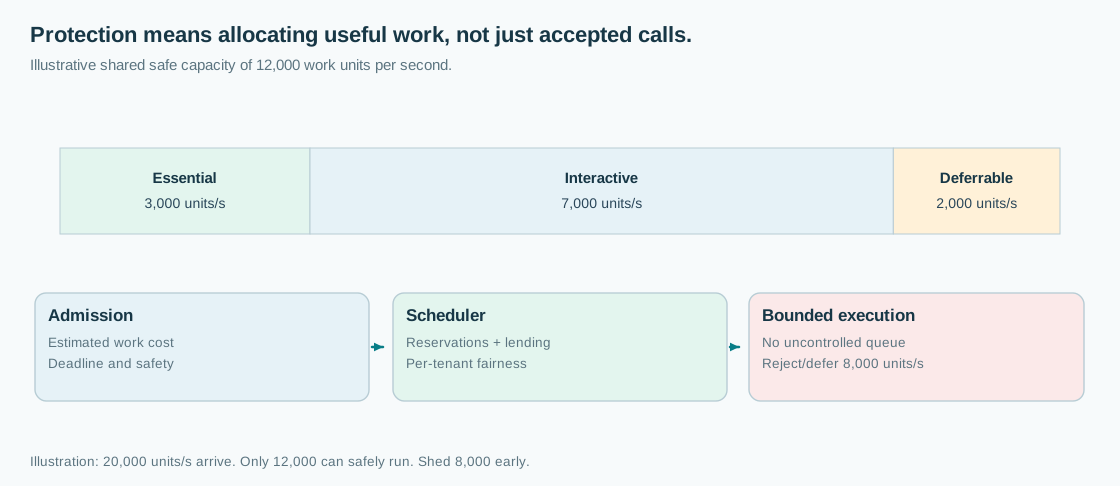
We need classes defined by outcomes. For example: Class A might be an authenticated payment confirmation or already-authorized refund, where delaying too long risks correctness or customer harm. Class B could be normal interactive checkout and account changes. Class C covers recommendations and discretionary dashboard queries. Class D contains offline exports and cache warming. This is not simply a pricing hierarchy. Some free-user operations have higher criticality than paid-user analytics. A failed fraud verification might require stronger protection than a paid marketing search.
One workable starting policy reserves 3,000 units per second for essential transaction completion, 7,000 for ordinary interactive traffic, and 2,000 for deferrable work. Those numbers are illustrative capacities, not automatically sensible ratios for every business. A work-conserving scheduler can lend unused reservations to another class, so capacity does not sit idle during quiet periods. The lending must be bounded so critical work can reclaim its share promptly when demand returns. If a background job starts a thirty-second uninterruptible query after borrowing protected capacity, the reservation exists only on paper.
That leads to admission versus preemption. Dropping an expensive request before it starts saves capacity. Stopping it after it has mutated inventory or captured a payment can create a correctness problem. Protect irreversible operations with explicit state transitions and allow controlled completion or compensation. For purely read-only analytics, cancellation and short execution deadlines make work stealing much safer. A scheduler cannot guarantee strict priority over a resource it cannot preempt or meter.
Within each class, add fairness by tenant or principal. Weighted fair queuing and deficit round robin are examples of schedulers that give multiple flows opportunities to progress despite unequal request sizes. With cost-aware scheduling, a tenant's large export consumes more credit than a cheap read. A practical implementation uses per-tenant bounded queues, weight or minimum-share policy, and admission counters near the scarce resource. A queue per tenant alone does not isolate shared workers or database pools. Shared asynchronous queues require their own isolation and fairness policy. Here the learning decision is who may consume scarce synchronous API capacity right now.
Consider a numerical spike. We have 20,000 requested work units per second and capacity for 12,000. Suppose all 3,000 essential units must be served, 9,000 units of other work remain eligible, and 17,000 nonessential units arrive. The nonessential classes together cannot receive more than 9,000. A priority scheduler should reject or defer 8,000 units early rather than admit all 17,000 and let them time out. The exact assignment depends on the contract, fairness weights, starvation floors and the cost of each task. Do not call those rejected units successful completions in throughput graphs.
Is starvation ever acceptable? Some best-effort workloads can be delayed for minutes, but a permanently starved free tier can become a broken product. Define a guaranteed minimum share or maximum waiting bound if the business promises one. Low-priority queues need caps and deadline checks because yesterday's recommendation refresh is not useful tomorrow. Where work is durable and reschedulable, enqueue it rather than forcing an HTTP request to wait. But queue acceptance is a different contract from completed work, and the acknowledgment must be honest.
The HTTP response should reveal the decision without disclosing private policy details. For a client-specific quota violation, 429 with a meaningful retry hint may fit. If the entire service is unable to accept work because of temporary capacity shortage, 503 can better describe system overload. Both require clients to respect deadlines and avoid multiplying traffic with synchronized retries. A paid tier may earn a higher weight or explicit reservation, but that does not justify indefinite retries or letting authorized requests bypass security checks.
Operationally, I want admitted and completed useful work by class and tenant, error rates, shed demand, queue age, wasted work, deadline expiry, and starvation duration. Simulate a major tenant surge, partial-region outage, sudden arrival of critical refunds, misclassified priority tags and an internal batch job holding too many database connections. A caller must not be allowed to label its own request “critical” merely by sending a header. The server assigns class from verified identity and operation semantics.
The engineering answer is not “premium wins.” It is a capacity allocation contract that preserves essential correctness, delivers useful work under shortage, and explains exactly which customers lose service first and for how long. That answer can be debated openly with product, security, reliability and customer teams before the next real overload makes the decision for them.
Go deeper
Strict-priority scheduling can starve lower classes indefinitely. Weighted fair queuing approximates sharing a resource among active flows, while deficit round robin can account for differently sized tasks with per-flow credits. Neither solves an inaccurate cost model or an unbounded execution time. Protect the scheduler against extremely high-cardinality tenant queues and poisoned identities. Reserve capacity for administrative recovery work separately if ordinary traffic would otherwise crowd out health-check or remediation actions.
Check your reasoning
- Translate requests into estimated work costs and total safe capacity.
- Define essential versus discretionary work independently from paid tier alone.
- Reserve and lend capacity with rules for non-preemptible operations.
- Protect lower classes and tenants from starvation through fair policy and bounded queues.
- Use correct rejection/defer semantics and measure successful work and starvation.
Common mistake: Strict premium-user priority is the best fairness policy because those users pay the most.
Read the answer explanation
Allocate capacity by criticality and cost, use per-tenant fairness and shed low-value work early — Priority alone can starve essential operations and other tenants. Fairness, cost and non-preemptible work must all be part of an overload contract.
Apply it elsewhere
A multi-tenant CI service has short interactive tests and hours-long builds. Design fair scheduling for expensive jobs with retries, customer weights and bounded cancellation without claiming all jobs have the same cost.
Compare your approach
Define cost and capacity units, make priority independent of arbitrary client claims, handle non-preemptible work, reserve and lend capacity, prevent tenant starvation, provide honest admission outcomes and measure useful completions by class.
One more constraint
If premium traffic is the highest priority, is it safe to allow a premium customer's long-running export to occupy every database connection during payment capture?
Quick revision
Overload protection is about useful work, not accepting the most requests. Classify work by customer and correctness criticality, allocate bounded capacity, lend unused reservations carefully, and shed expired or low-value work before it consumes scarce resources. Protect against tenant monopoly with fair scheduling and verified identity. Cost differences, non-preemptible operations and downstream pools determine what admission can actually guarantee. Monitor completed outcomes, rejection and starvation, not just average latency.
References
- Handling overload and criticality · Google SRE
- Using load shedding to avoid overload · AWS
- HTTP 429 semantics · IETF