Why Jev Is So Fast: What System One Models Remove from LLM Inference
Why Jev can return decisions in hundreds of milliseconds. A technical look at LLM decode, parallel decisions, latency, throughput, benchmarks, and what TypeSafe has not disclosed.
On this page
When Jev launched, the number that immediately got attention was latency. TypeSafe reported roughly 70 ms to 500 ms end to end for Jev and much larger numbers for frontier models on the decision workloads they evaluated. Two weeks later there is at least some independent evidence that the latency class is real. A collection of public evaluations from independent builders currently shows single request median latency mostly between roughly 154 ms and 422 ms, although the accuracy results vary a lot more depending on the task. These are still small, non peer reviewed experiments, but the speed is showing up outside TypeSafe's own benchmark now.
What I find more interesting is not whether Jev can return something in 200 ms. The more useful question is what changed in the computation that makes this latency possible.
It is easy to describe Jev as a faster LLM because both systems read text and produce something that software uses. I do not think that mental model helps much. A normal LLM is designed around generating a sequence whose contents are not known before inference. Jev is designed around answering questions where the shape of the possible answer is already known. That changes the amount of work on the critical path, the serving choices available to the model provider, and even how I would structure the application around it.
Consider a customer support system where the application needs to decide whether a request should be refunded, reviewed by a human, or denied. With an LLM we might ask for a JSON object such as:
{
  "decision": "REFUND",
  "confidence": 0.97
}
That is already a good production interface compared with asking the model to return arbitrary prose, especially when constrained structured output is available. But the underlying model is still generally solving the problem through a language generation path.
Jev starts with another contract. The state is provided, the allowed answers are declared before inference, and the model returns probabilities over those answers. TypeSafe describes Jev as a System One model built around typed questions, probability distributions, a parallel sampler, and a training method called Reinforcement Learning for Calibrated Decisions. It also says multiple outputs can be produced in parallel within one query.
That is not just a nicer API. It changes the serving problem.
Before explaining the speed, I would be careful about what we actually know#
Jev's internal model architecture is not public.
TypeSafe has not published the parameter count, hidden dimensions, attention design, serving hardware, batching implementation, number of internal model passes, or enough of the RLCD training recipe for somebody outside TypeSafe to reproduce the model. We also do not know whether the underlying architecture looks more like an encoder, a modified decoder, a diffusion model, a model with specialized readout heads, or something different.
There are already projects that implement Jev shaped decision interfaces with several of those approaches, but that tells us what kinds of systems can implement this computational contract. It does not tell us how Jev itself is built. The independent System One ecosystem now includes models built from architectures such as Qwen based models, which is useful evidence that the interface does not imply one specific neural architecture.
So I would separate two questions.
One is:
What neural architecture did TypeSafe build?
We do not know.
The other is:
Why can a model that returns bounded decisions
have a very different latency profile from
a model generating arbitrary text?
We can say quite a lot about that without guessing what is inside Jev.
The normal LLM serving path has a sequential part that is difficult to remove#
A decoder based language model request has two phases that are useful to think about separately.
The first is prefill. The model processes the input tokens and builds the internal state needed for generation, including the KV cache in a transformer serving system.
The second is decode. The model produces new tokens.
A simplified path looks like this:
Input tokens
     |
     v
   Prefill
     |
     v
  KV Cache
     |
     v
   Decode
     |
     v
  token 1
     |
     v
  token 2
     |
     v
  token 3
     |
     v
    ...
The important property of autoregressive decoding is dependency.
Conceptually:
P(t1 | input)

P(t2 | input, t1)

P(t3 | input, t1, t2)

P(t4 | input, t1, t2, t3)
The model cannot finalize token four before token three exists because token four is conditioned on it. Providers have done enormous amounts of engineering to make this loop fast, including continuous batching, speculative decoding, prefix caching, optimized attention kernels, quantization, tensor parallelism, better KV cache management, and hardware specific inference kernels. Those techniques can dramatically improve both throughput and latency, but they do not completely remove the dependency between generated tokens.
For a task where the output is the product, that is completely reasonable. If I ask a model to explain a production incident, write a migration plan, generate code, or reason through a complicated architecture change, I actually want a sequence of output tokens.
The situation is stranger when the application only needs:
BILLING

TECHNICAL

FRAUD
We may be paying for a language generation abstraction only to recover one bounded decision at the end.
Structured output improves the interface, but it does not automatically remove decode#
This distinction is important because it is easy to compare Jev with an old style LLM application that asks for JSON and occasionally gets broken JSON. Modern structured output is much better than that.
A constrained decoder can prevent many invalid outputs and make a normal LLM reliable enough to use as a software component. If the schema says:
{
  "queue": "BILLING | TECHNICAL | FRAUD",
  "priority": "LOW | MEDIUM | HIGH"
}
the inference stack can constrain which tokens are legal while generation proceeds.
That removes a large class of parsing and schema failures.
But constraining generation is not necessarily the same as eliminating generation.
The model can still be moving through an autoregressive output sequence in order to represent the decision as language tokens. A model designed from the beginning to score a bounded answer space does not necessarily need that representation step at all.
This is one of the places where Jev's interface matters more than it first appears. A Choice question does not ask the model to compose the word BILLING as language. It asks the system to decide among known alternatives and return the distribution.
That gives the serving stack a different problem to optimize.
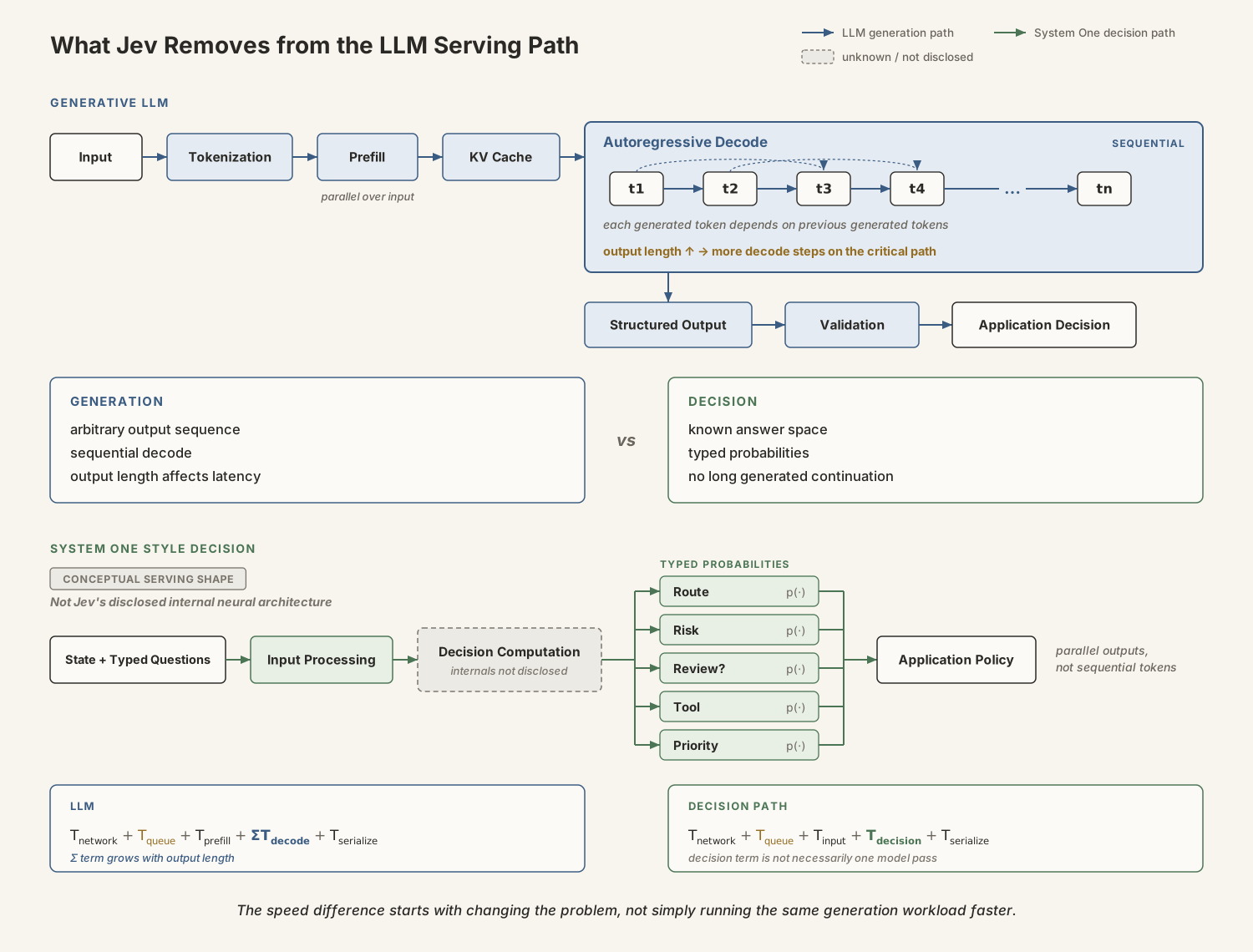
A generative LLM has sequential output generation on the critical path. A System One style workload already knows the answer space, so the serving path does not need to produce a long token continuation before software can recover the decision.
Removing long sequential decode changes the latency equation#
For a normal LLM API call, I think about latency roughly like this:
T request =

T network
+
T queue
+
T tokenize
+
T prefill
+
T decode
+
T serialize
And:
T decode =

sum of the sequential decode steps
needed for the output
This is simplified, but it explains why time to first token and total generation time are separate measurements for language models.
If the model returns 10 tokens, there are fewer decode steps on the critical path than if it returns 500 tokens.
For a bounded decision system, the conceptual request path can look more like:
T request =

T network
+
T queue
+
T input processing
+
T decision computation
+
T serialize
The important difference is that there does not need to be a long user visible token sequence generated one token after another.
I am deliberately not saying that Jev performs one neural forward pass. TypeSafe has not published enough information to establish that. A parallel output interface does not prove a single internal pass, and an implementation could perform additional internal computation that is invisible at the API.
What the public description does support is that Jev is not producing its answers through normal sequential text generation. TypeSafe explicitly describes a parallel sampler and parallel outputs.
That is enough to explain why the latency envelope can be fundamentally different.
There is a hardware reason decode is painful too#
The prefill and decode phases also behave differently on accelerators.
During prefill, a large number of input tokens create substantial matrix operations that GPUs can execute with high parallelism. Decode is different because each active sequence usually advances by one token at a time. At lower batch sizes, the serving system can spend a lot of time moving model weights and KV cache data through memory while not using all available arithmetic throughput efficiently.
Providers solve part of this by batching many active sequences together.
That creates another tradeoff. Waiting for more work can improve hardware utilization and throughput, but waiting also adds queueing latency. Once a service operates close to saturation, tail latency can increase very quickly even if the median still looks good.
This is why I would not reduce Jev's performance story to:
parallel = fast
The more interesting point is that removing the requirement to produce an arbitrary sequential continuation gives the serving system different choices around batching, scheduling, memory movement, and how decision outputs are represented.
TypeSafe describes Jev's sampler as both parallel and hardware aware, but it has not published enough serving detail for us to say exactly how those optimizations are implemented.
So I would not claim that Jev is fast because of a particular GPU technique.
The defensible statement is narrower. Jev's computational contract removes the need for normal token by token output generation, and that changes the serving problem substantially.
Multiple questions against the same state may be just as important as fast individual decisions#
A production decision system rarely needs only one judgment.
Take a support ticket. The application may want to know the intent, priority, fraud risk, whether a human should review it, whether a refund looks justified, and which queue should receive it.
One implementation is to make six model calls.
state -> model -> intent

state -> model -> priority

state -> model -> fraud

state -> model -> review

state -> model -> refund

state -> model -> queue
That is usually a bad use of an LLM too. If I were using a generative model, I would normally ask for all six fields in one structured response so the state is not repeatedly processed.
Jev makes this pattern part of the interface itself. One state can be submitted with several typed questions, and TypeSafe says those outputs are produced in parallel.
Conceptually:
                         intent
                           ^
                           |
                         priority
                           ^
                           |
State + Questions -----> fraud
                           |
                           v
                         review
                           |
                           v
                         refund
                           |
                           v
                         queue
This is where I think the System One abstraction becomes interesting from a system design perspective.
We can amortize the state and parallelize the decisions.
I would be careful with the word amortize because TypeSafe has not said that Jev literally encodes the state once and reuses one hidden representation across every question. That would be an architecture claim we cannot support.
What the API does let the application amortize is request construction, network overhead, repeated transmission of the same state, and whatever internal reuse TypeSafe's implementation is capable of providing. The service is also free to schedule those decisions together instead of forcing the application to create a serial chain of model calls.
That matters because model latency often becomes painful through composition.
A 200 ms call does not sound expensive.
Five sequential 200 ms calls already create a one second model path before we count application work, queueing, network variance, or retries.
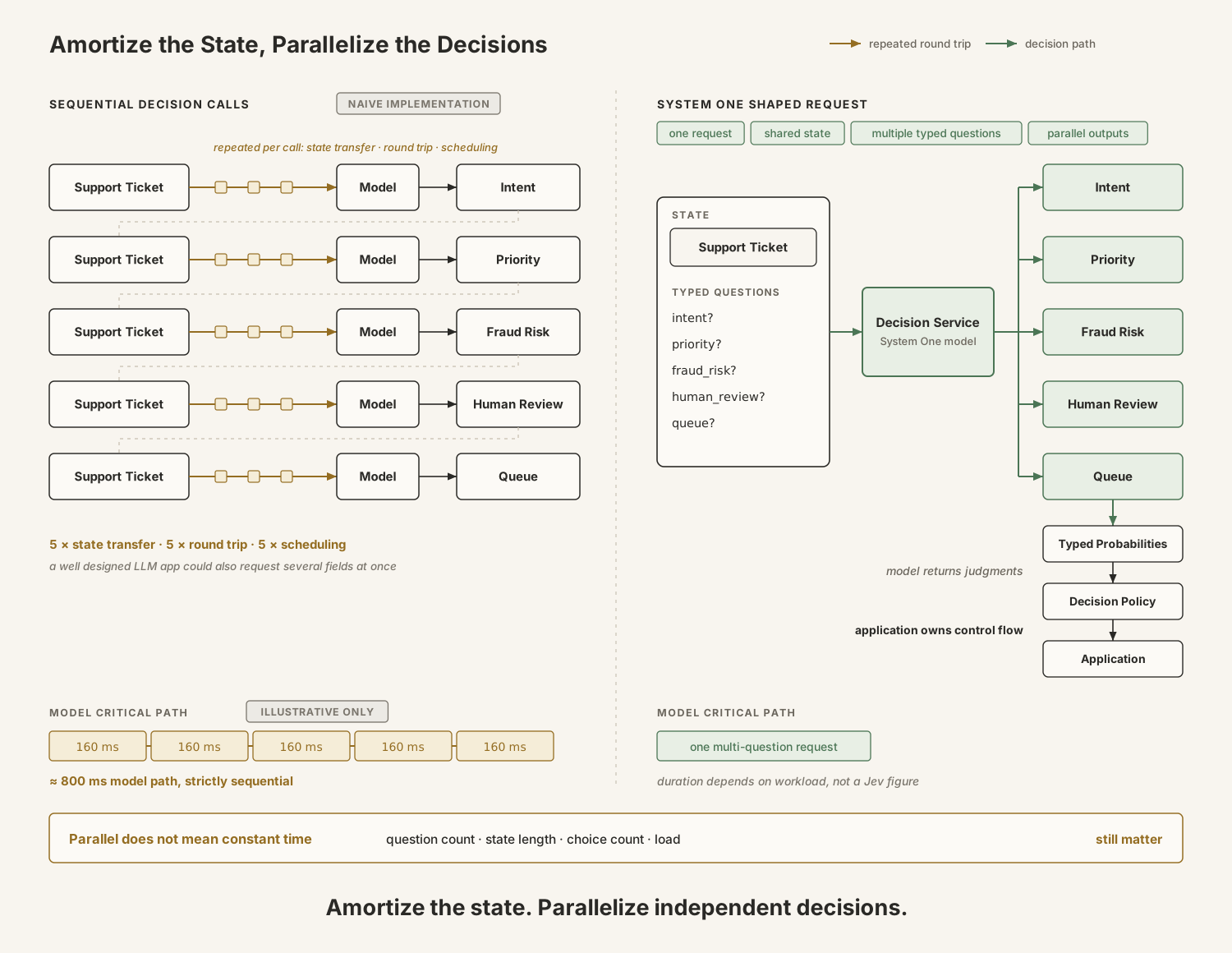
Decision heavy workflows often make several judgments over the same state. Grouping independent questions into one request can reduce repeated state transfer and serial model round trips, while leaving the provider free to execute those decisions together.
There is a second source of speed outside the neural model#
Inference time is not the only latency in a production decision path.
A traditional LLM integration can contain:
LLM inference
      |
      v
structured output
      |
      v
schema validation
      |
      v
business validation
      |
      v
decision
Modern structured output can make this path reliable, so I would not exaggerate parsing failures as though we were still in 2023. But bounded model outputs can still simplify the application because the answer space is part of the request contract rather than a schema that the language model has to express through text.
If I declare:
ALLOW
REVIEW
DENY
Jev cannot return:
PROBABLY_ALLOW
It can absolutely choose ALLOW when DENY would have been correct. The type system does not solve semantic accuracy.
TypeSafe describes this property as zero hallucination, but I think the phrase needs that qualification whenever we use it. It is zero out of type output, not zero incorrect decisions.
From the application side, that still removes useful failure modes. There is less repair logic, fewer schema surprises, and less reason to create fallback generation calls because the output shape was malformed.
Those savings may be small compared with model execution, but they matter at high request volume and they matter even more at the tail when retries start multiplying latency.
Parallel does not mean constant time#
This is another place where I would be skeptical of a simplistic performance story.
If Jev evaluates one question in 200 ms, that does not imply that 100 questions, 30,000 input tokens, and hundreds of candidate choices will also take 200 ms.
Somewhere, more work has to be done.
The public benchmark data already shows this. The independent benchmark collection reports sub 500 ms medians for many single question workloads, while one five question benchmark is reported around 925 ms to 1,068 ms.
That does not contradict parallel execution. Parallel systems still have finite compute, memory bandwidth, scheduling overhead, and synchronization cost.
The same is true for Choice cardinality. Jev exposes bounded options rather than an unbounded vocabulary, but increasing the candidate set still creates work somewhere in the system.
So if I were capacity planning around Jev, I would not start with:
latency = 200 ms
I would start with a workload shape:
state tokens = 1,000
questions = 6
average choices = 5
concurrency = 100
region = us west
and benchmark that.
Then I would change one dimension at a time.
Input processing does not disappear just because output generation does#
This becomes important for RAG and agent workloads where the state can be large.
If I send 500 input tokens, the system has one workload.
If I send 30,000 tokens, it has another.
Even if the output is one decision, those 30,000 tokens still have to be processed somehow.
The current System One model documentation lists a 64K request context for Jev.
That is useful capacity, but I would not treat it as an invitation to send everything the application knows.
The same state construction discipline from designing Jev into a production system still applies. If a decision needs 2,000 useful tokens, sending 25,000 mostly irrelevant tokens increases work and can hurt decision quality as well.
For latency testing I would therefore measure at least:
P50
P95
P99

by state length

by question count

by choice cardinality

by concurrency

by region
A single average latency number hides too much.
Tail latency matters more once Jev enters the synchronous request path#
This is one of the reasons the low latency is architecturally interesting.
A 20 second model is usually placed somewhere asynchronous or behind a user interface that already expects a wait.
A 150 ms decision model can move into places such as request routing, tool selection, guardrails, retrieval filtering, and policy checks.
Once that happens, the performance requirement changes.
If Jev sits on every API request, I care less about a beautiful median and much more about what happens at P95 and P99 when traffic increases.
The end to end latency becomes:
T total =

application work
+
network
+
Jev queue
+
Jev execution
+
policy
+
downstream action
If Jev is normally 180 ms but becomes 1.5 seconds under load, it can dominate the whole request.
This is where queueing behavior matters. As utilization approaches the capacity of a serving tier, waiting time can increase much faster than average service time. That is true regardless of the model architecture.
I would want load tests that increase concurrency until tail latency starts bending upward, then keep enough headroom below that point.
I would also want to know whether several Jev decisions can be combined into one request because reducing the number of network round trips can matter as much as shaving another few milliseconds from inference.
I would separate latency, throughput, and service capacity#
These numbers are related but they are not interchangeable.
Latency asks how long one request takes.
Throughput asks how much work the system can finish per unit time.
Capacity asks how much sustained load the deployed service can absorb while still meeting the required latency and error targets.
A model can have excellent single request latency and poor throughput.
Another model can have higher latency but process large batches extremely efficiently.
TypeSafe's current service information lists 250,000 input tokens per second and 1,200 requests per minute. Those are API rate limits, not measurements of the maximum physical throughput of the model or TypeSafe's underlying fleet.
We do not know how many replicas TypeSafe runs, what accelerators they use, what batch sizes they target, how requests are scheduled, or how much additional capacity sits behind the published limit.
So I would never derive a capacity model from those rate limits.
For a real deployment, I would load test the service using the actual state sizes and question distributions expected in production.
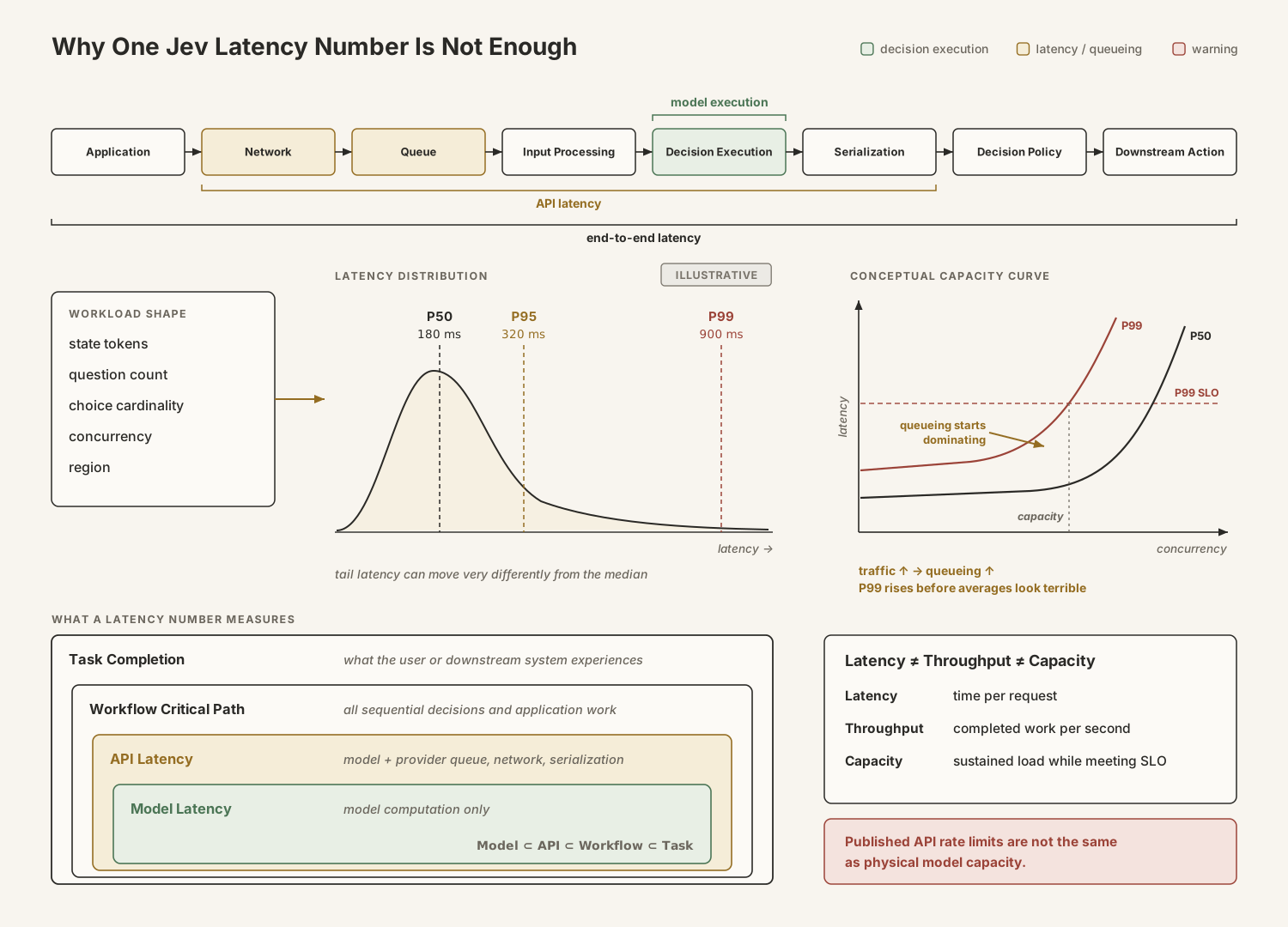
A production latency claim needs a workload shape and a distribution. State length, question count, choice cardinality, concurrency, region and queueing can all change the result, while model latency itself is only one part of the workflow critical path.
I would also separate RLCD from the latency explanation#
Reinforcement Learning for Calibrated Decisions is one of the interesting parts of Jev, but it answers a different question.
RLCD is about training the model to make useful probabilistic decisions. TypeSafe says that is the training method used for System One models. The company has not published enough detail to independently reproduce the method yet.
Latency is a serving property.
Training determines the weights and behavior.
Serving determines how much computation those weights require at inference, how that work maps onto hardware, and how the system schedules requests.
RLCD may be essential to why the fast decision model is accurate enough to be useful, but I would not say RLCD is why Jev answers in 200 ms unless TypeSafe publishes evidence connecting the two.
The more defensible latency explanation comes from the workload contract, bounded outputs, parallel sampling, and the absence of normal free form autoregressive output generation.
There is a real tradeoff hidden inside the speed#
A normal reasoning model can spend more computation when a problem is difficult.
The exact mechanism depends on the model and provider, but from the application perspective we can allow the model to spend several seconds or much longer working through an ambiguous problem, generating intermediate reasoning internally or externally before returning the result.
That extra computation is expensive.
Sometimes it is also the reason the model gets the problem right.
Jev's current public strengths are concentrated in tasks that look like classification, routing, ranking, relevance, verification, and other bounded decisions. Independent benchmark results are already showing this shape. Jev performs strongly on several classification, routing, reranking, and failure attribution tasks, while other models or trained classifiers win on some extraction, phishing, and labelled classification workloads.
This is why I would not interpret the latency as evidence that we somehow compressed every reasoning problem into a few hundred milliseconds.
If the task is:
Which queue should receive this ticket?
there may be no value in producing a long reasoning sequence.
If the task is:
Why did this distributed transaction fail only
during cross region failover and what migration
should we implement?
I want a model that can spend more computation.
The architectural tradeoff is closer to:
bounded decision computation

versus

open ended adaptive computation
rather than fast intelligence versus slow intelligence.
This is also why Jev and LLMs fit together naturally. A fast decision model can decide whether a task is routine, risky, ambiguous, or expensive enough to justify a stronger reasoning model. The reasoning model can do the open ended work, and another bounded decision can check the result before the application acts.
Model latency can look great while workflow latency barely improves#
This is where benchmark numbers frequently become misleading.
Suppose Jev takes 150 ms and the LLM alternative takes 900 ms.
At the model level, Jev looks six times faster.
Now suppose the application turns one LLM call into four sequential Jev calls:
Jev
 |
 v
Jev
 |
 v
Jev
 |
 v
Jev
Ignoring everything else, that path is already around 600 ms.
The workflow did not become six times faster.
Now consider another implementation where four independent questions are submitted together:
State + Questions
       |
       +---- decision A
       |
       +---- decision B
       |
       +---- decision C
       |
       +---- decision D
The result can be very different because the application removed three model round trips from its critical path.
This is why I would keep five latency concepts separate when evaluating Jev:
model execution latency

API round trip latency

decision service latency

workflow critical path latency

task completion latency
The user or downstream system experiences the last one.
A model benchmark only tells us part of that story.
The comparison model matters just as much as the Jev number#
TypeSafe reports speed advantages between roughly 40x and 200x in some of its own evaluations against frontier models. Those are TypeSafe's benchmarks, and the company itself describes the largest gains as being on the high end of what it expects in real workloads.
The important question for an engineering team is not whether Jev is 100 times faster than a large reasoning model.
It is whether Jev is better than the system we would otherwise deploy for this decision.
For ticket routing, the actual alternatives might be:
rules

traditional classifier

fine tuned encoder

small LLM with structured output

Jev

frontier LLM
If we have ten million labelled tickets, a small classifier trained specifically for that task may beat all of them on latency, cost, and accuracy.
If the decision changes frequently and labelled data is scarce, Jev may be much more attractive.
If the task requires complicated reasoning over ambiguous evidence, the LLM may be worth the latency.
A Principal level architecture decision should compare those alternatives rather than choosing the most dramatic benchmark denominator.
The independent results are useful because they show both the strength and the limitation#
The public benchmark picture is still young, but it is already more useful than it was at launch.
The current independent benchmark collection includes at least twenty builder evaluations. The strongest agreement is around latency. Single call medians reported in those experiments are mostly below half a second, including one 200 case routing benchmark where Jev was reported at 154 ms median. Other independent tests report values in the 300 ms to 400 ms range.
Accuracy is much more task dependent.
On some topic classification, routing, reranking, and agent failure attribution tasks, Jev performs very well relative to the compared LLMs. On other tasks, including some phishing and structured extraction evaluations, other models win. A traditional classifier trained on labelled data also beats Jev on at least some classification benchmarks.
Calibration varies too.
That last point is important because Jev's probability distribution is only useful for production automation if confidence actually corresponds reasonably well to correctness on the workload we care about.
A 200 ms answer with badly calibrated probability may still require conservative thresholds and more human review, which can erase part of the workflow advantage.
The speed looks increasingly credible.
The decision quality still needs to be measured task by task.
I would benchmark Jev differently from a normal model benchmark#
If I were evaluating Jev for production, I would start with a real decision from the system rather than a generic intelligence benchmark.
Suppose the decision is support routing.
I would freeze a production representative dataset and compare rules, the current classifier if one exists, a small structured output model, Jev, and whatever larger model we would realistically deploy.
Every system sees the same cases.
For quality I would measure accuracy where a single correct label exists, class specific precision and recall where the cost of errors differs, calibration through metrics such as expected calibration error or Brier score, and coverage if the system can abstain.
For performance I would measure P50, P95, and P99 rather than only average latency. I would run tests from the same region, reuse connections consistently, vary concurrency, and record state tokens, question count, and candidate cardinality.
Then I would increase load until queueing becomes visible.
For cost I would measure the complete task rather than only the model call. If one model decision causes another downstream model request, human review, retry, or retrieval pass, that belongs in the economics of the decision.
Finally I would run the complete workflow.
That is where I would expect the biggest architectural difference to appear. A 200 ms decision that removes several later calls can have much more value than its isolated latency suggests. A 200 ms decision that adds another model hop to an already healthy path can make the system slower.
The Jev style clones make one thing clearer#
Several developers and vendors have already implemented System One shaped models using architectures different from whatever TypeSafe may be using internally. The current ecosystem includes Tev1, a 4B experimental decision model based on Qwen 3.5, among other community approaches.
I would not use those projects to reverse engineer Jev.
I would use them as evidence that the useful abstraction may be bigger than one model.
The abstraction is:
state

+

known questions

+

known answer spaces

+

probabilities
Once the workload is expressed that way, an implementation no longer has to solve the general problem of arbitrary text generation. Different architectures can compete on the same decision interface.
That is more interesting to me than guessing whether Jev has an encoder or a specialized decoder.
If System One models become a real category, the long term competition may be around which architecture can produce the best calibrated decision distribution for a given latency and cost envelope.
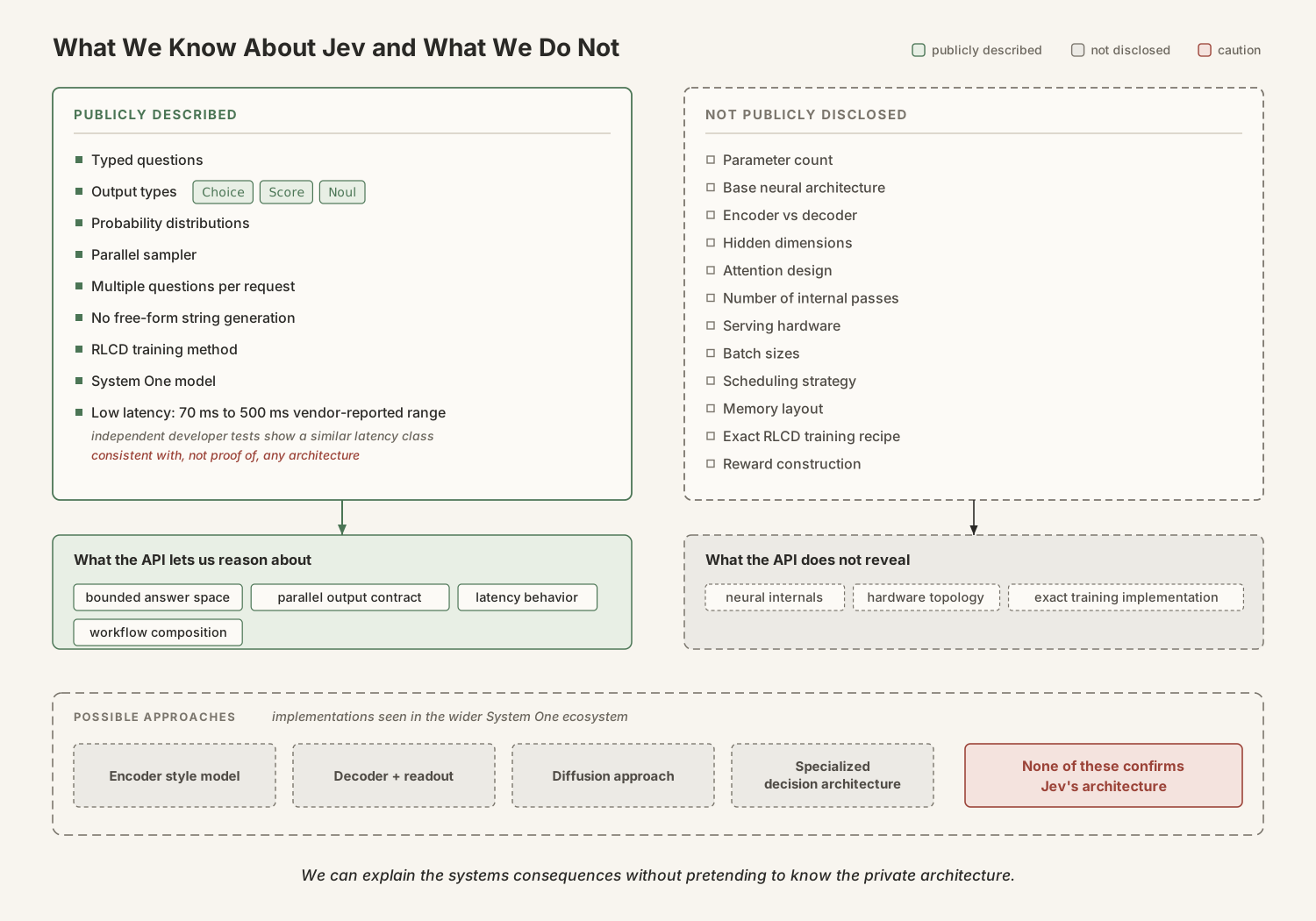
Jev's public contract is enough to reason about bounded decisions, parallel outputs and serving behavior, but it does not reveal the model's neural architecture, hardware topology or detailed training implementation.
What I think we can responsibly say today#
The public evidence supports that Jev returns typed decisions and probabilities rather than free form generated prose, that TypeSafe built a new architecture and parallel sampler for the model, that multiple questions can be handled in a single request, and that both vendor and early independent measurements put many Jev calls comfortably below half a second.
The public evidence does not tell us the parameter count, neural architecture, number of internal passes, hidden representation, serving hardware, batching implementation, memory layout, detailed RLCD recipe, or the exact reason one Jev request takes 180 ms while another takes 400 ms.
That boundary is important because we do not need the private architecture to understand the systems lesson.
For the last several years we have pushed an enormous range of software decisions through one abstraction, text in and text out. That worked so well that it became easy to forget how much machinery exists specifically to generate the output sequence.
For writing, coding, investigation, planning, and open ended reasoning, that machinery is useful because the sequence itself carries the work.
For routing, ranking, classification, filtering, verification, and other bounded decisions, the sequence may only be an intermediate representation that the application immediately throws away.
Jev changes that contract. It takes state and known questions, then gives software typed probability distributions that can be consumed directly. Once generation is no longer the product, sequential decode no longer has to dominate the serving path, several decisions can be grouped around the same state, and the infrastructure can optimize for a much narrower problem.
That does not make Jev a faster version of every LLM workload. It explains why it can be dramatically faster on the workloads it was designed for.
And I think that distinction is the more important idea behind System One models.
Keep reading
Continue with a guided sequence of free production engineering essays.
Find your next reading pathRelated reading
Continue this path
Designing Production AI Systems with Jev
Jev is useful when an AI system needs fast bounded decisions around generative work. The production design still needs state construction, versioned questions, policy, calibration, observability, and clear boundaries around when to act, escalate, or collect more evidence.
Read essayA Skill Is Not a File. It Is a Deploy: Designing Agent Skills Infrastructure
Production Agent Skills are deployments, not files. They need immutable versions, controlled rollout, revocation, trust boundaries, progressive resolution, and a runtime path designed for scale.
Read essayDesigning Identity and Delegation for Production AI Agents
Production AI agents need explicit human identity, managed agent identity, trusted workload identity, narrow delegation, and an evidence chain that survives every authorization hop.
Read essay